

England Is Diagnosing More Cancer. Are We Catching It Earlier?
New NHS figures reveal a record number of cancer diagnoses in England — alongside encouraging progress in earlier detection. What is changing, and what does it mean for patients?
By Dr Femi Olaleye
Global Health Specialist & Cancer Prevention Expert | Founder & CEO, BloomShield CIC
Published by BloomShield Insights
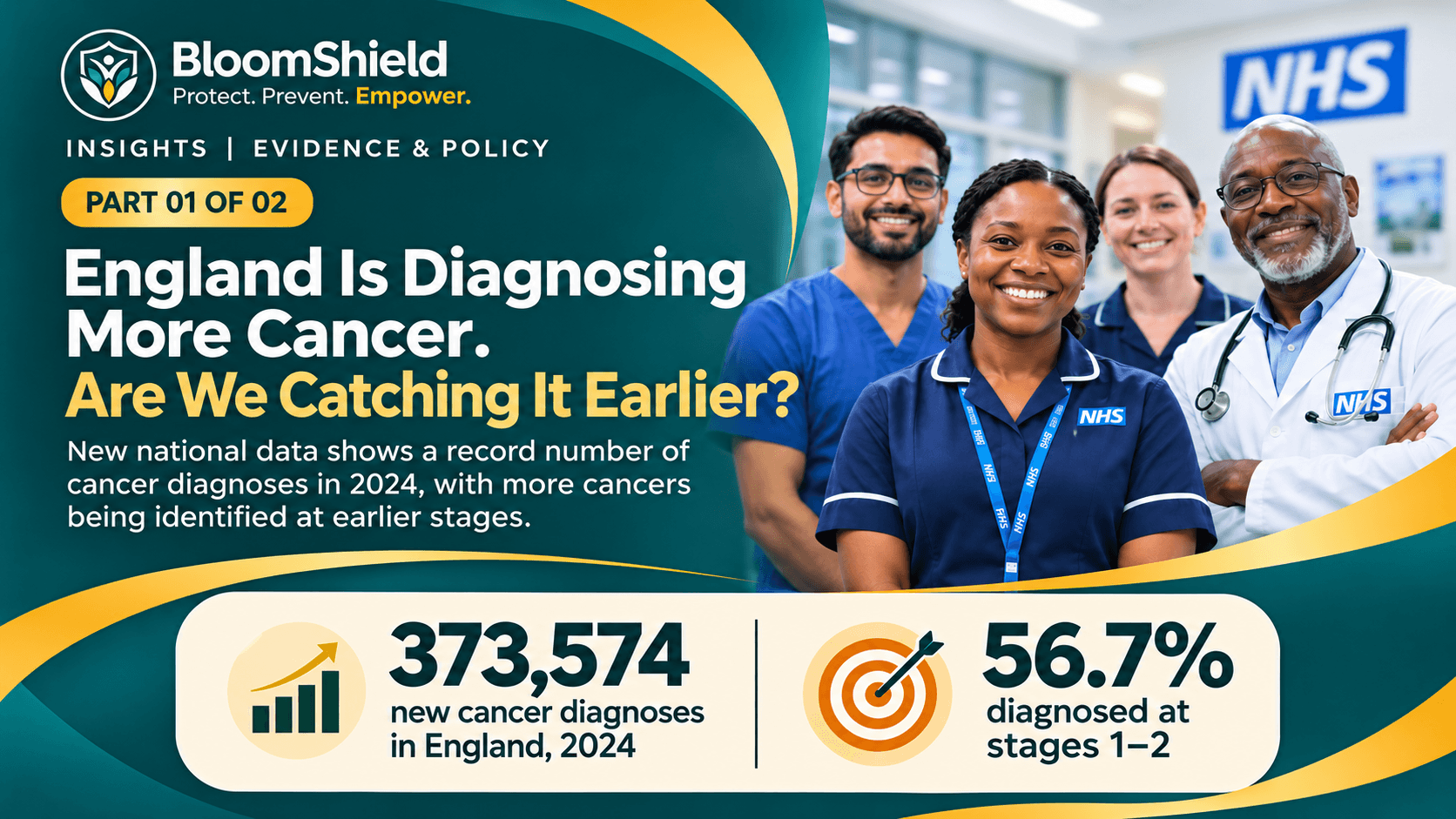
More diagnoses. A promising shift towards earlier detection.
1,021 cancer diagnoses every day.
That is the average recorded in England during 2024, according to NHS cancer registration statistics published on 5 November 2026.
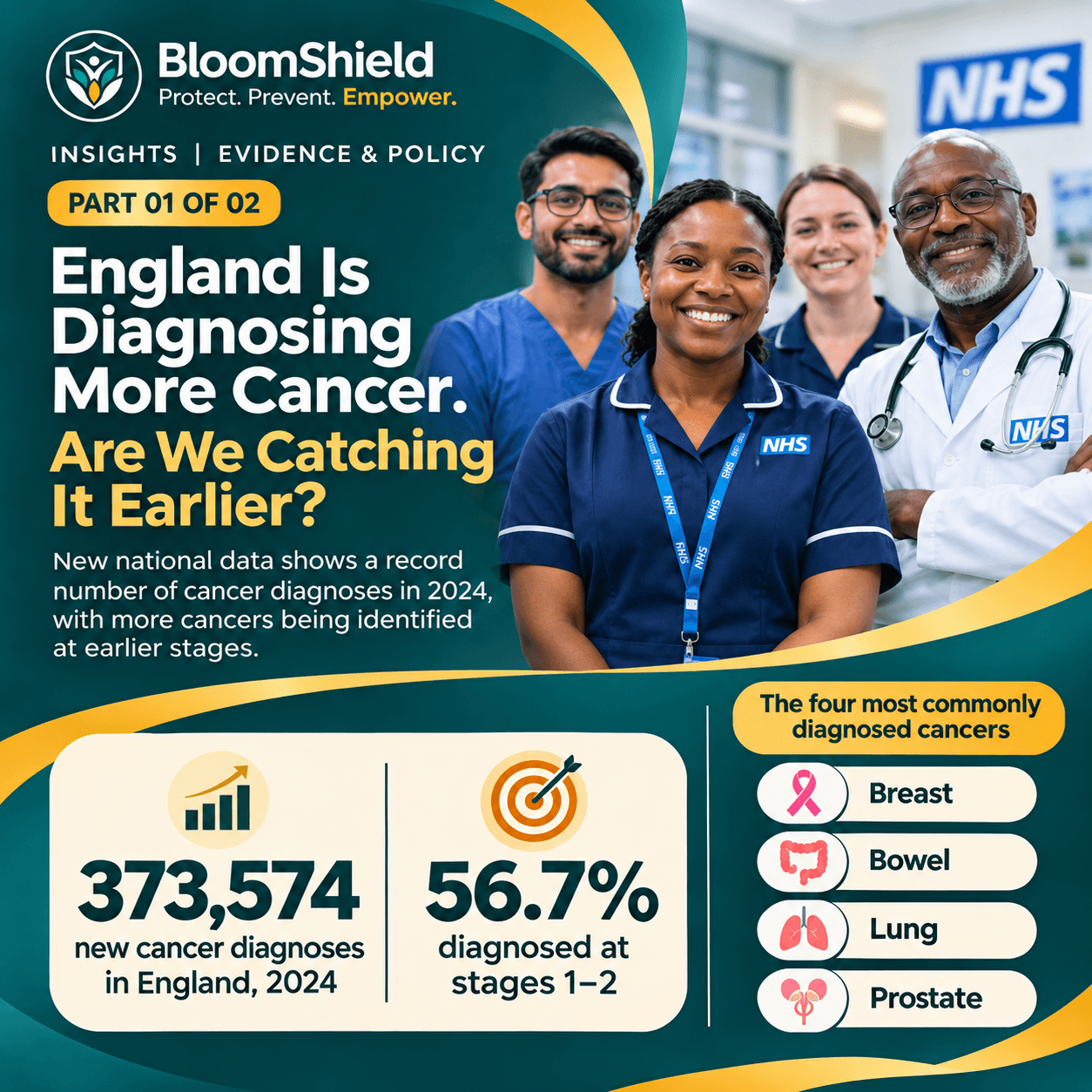
Across the year, 373,574 new cancers were diagnosed, excluding common non-melanoma skin cancers — the highest annual total on record.
The number is striking. But another finding deserves equal attention.
According to reporting of the NHS England figures, 56.7% of first new cancers were diagnosed at stages 1 or 2 in 2024, compared with 55.8% in 2023.
That represents a modest but encouraging improvement in earlier diagnosis.
More diagnoses do not necessarily mean that cancer risk is increasing at the same rate. Population ageing, underlying risk and improved detection can all influence the totals.
The important question is whether more people are being diagnosed at a stage when treatment has a better chance of success.
The four cancers behind half of all diagnoses
Prostate, breast, lung and bowel cancers together accounted for approximately half of England's newly diagnosed cancers in 2024.
These four cancers illustrate the breadth of the NHS's approach to earlier detection.
Breast cancer: The NHS Breast Screening Programme uses mammography to identify cancers, including some before symptoms develop.
Bowel cancer: Home-based faecal immunochemical testing (FIT) helps identify people who may need further investigation.
Lung cancer: Targeted lung screening, including low-dose CT for eligible people at higher risk, is being expanded across England.
Prostate cancer: Unlike breast and bowel cancer, there is no routine population-wide prostate screening programme. Earlier diagnosis relies on appropriate clinical assessment, informed PSA testing and risk-based approaches.
Different cancers require different strategies. Not every diagnosis results from screening; many begin with symptoms, GP assessment or other diagnostic investigations.
Nevertheless, these pathways share an important ambition:
Find cancer earlier, when more treatment options may be available.
Recognition for the people behind the progress
These figures provide an opportunity to acknowledge the work taking place across the NHS.
From screening teams and radiographers to GPs, diagnostic specialists, Cancer Alliances and community organisations, earlier diagnosis depends on people working across different parts of the health system.
Efforts to expand screening, improve diagnostic capacity and bring services closer to communities are important contributions to that work.
The increase in the national early-stage proportion is encouraging, although these statistics alone cannot tell us how much of the improvement resulted from any individual programme.
And progress must be examined alongside continuing inequalities in who accesses screening, receives a timely diagnosis and benefits from care.
Earlier diagnosis is progress. But what happens next?
For BloomShield, this is where the next question begins.
Identifying cancer earlier is a major step. But diagnosis is not the end of the patient journey.
What happens between receiving a diagnosis and beginning treatment?
How quickly do patients move through the system?
And are those opportunities equally accessible across communities?
On 12 November 2026, NHS England is provisionally scheduled to publish its next cancer waiting-time statistics.
In Part 2, we will examine what those figures reveal about timely treatment, pathway continuity and the challenges that remain.
Because finding cancer earlier matters.
Making sure patients can access the treatment they need, without avoidable delay, matters just as much.
Coming next — Part 2
Diagnosed — But How Long Until Treatment Begins?
An examination of cancer waiting times, treatment access and the journey beyond diagnosis.
BloomShield Insights | Evidence & Policy
Protect. Prevent. Empower.
How did this insight land with you?
References
Contributor
About the author
Dr Femi Olaleye
Global Health Specialist & Cancer Prevention Expert
Founder & CEO, BloomShield CIC
Dr Femi Olaleye is a global health specialist and cancer prevention expert, and the founder of BloomShield CIC. His work focuses on equitable cancer prevention, screening access, implementation, community engagement and partnerships that translate evidence into practical improvements in cancer care.
Corrections, evidence or partnership follow-up
Suggest a correction, share relevant evidence or explore a partnership.
Cancer Care Partnership Ecosystem
CCPE Lens
This Insight is indexed through the domains most relevant to implementation and equitable impact.
Cross-cutting domains
- People
- Systems
- Equity
- Impact