Cancer screening in Medway: what the local data tells us
Local data. Local voices. Local action.
By Dr Femi Olaleye
Global Health Specialist & Cancer Prevention Expert | Founder & CEO, BloomShield CIC
Published by BloomShield Insights
Cancer inequalities may be national in scale, but they are experienced locally. Behind every percentage point is a person, a family and a community. Differences in screening coverage can shape who benefits from earlier diagnosis — and who remains more likely to be diagnosed later.
BloomShield Local Lens begins in Medway & Kent, examining what the data shows, where progress is being made, who may still be getting missed, and how community and system partners can respond.
From baseline to progress
When Medway’s Health and Wellbeing Board reviewed screening in April 2025, the 2023/24 baseline showed breast and bowel screening coverage below England, while cervical screening among people aged 50–64 was broadly similar.
- Breast: Medway 68.3% | England 69.9%
- Bowel: Medway 69.7% | England 71.8%
- Cervical, age 50–64: Medway 73.9% | England 74.3%
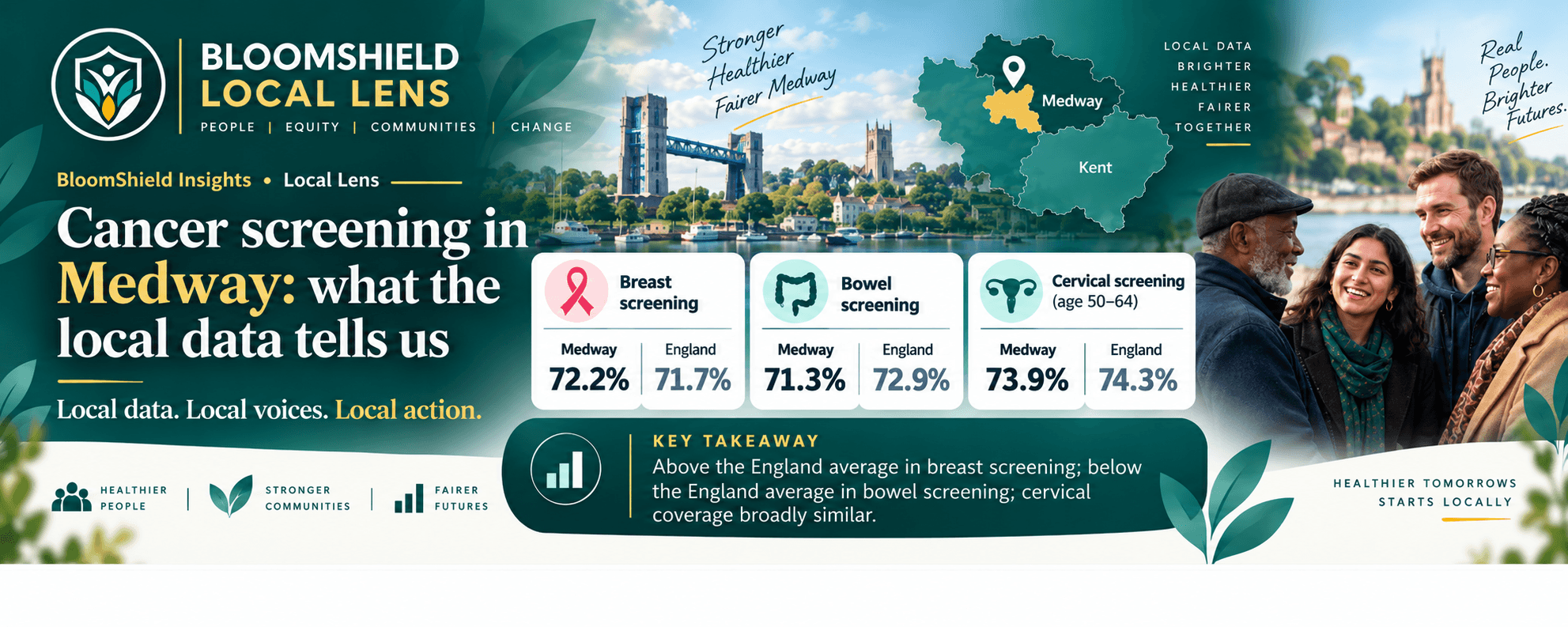
More recent figures show encouraging movement. In 2025, breast screening in Medway had risen to 72.2%, slightly above England at 71.7%. Bowel screening improved to 71.3%, although it remained below England at 72.9%.
For cervical screening in 2024, Medway was above England among people aged 25–49 (69.7% vs 66.1%) and broadly similar among those aged 50–64 (73.9% vs 74.3%).
So the headline is no longer simply that Medway performs below England. The more important equity question is: who within Medway is still least likely to benefit from screening?
The inequality gap beneath the average
The April 2025 review provides some important clues. Women invited for breast screening for the first time who lived in Medway’s most deprived areas had lower coverage than women elsewhere. Across Medway and Swale, 56% of breast cancers in the eligible population were detected through screening in the three years to March 2024, with detection highest in the least deprived quintile and lowest in the most deprived.
For bowel cancer, the disparity was more striking: people living in more deprived parts of Medway were reported to be seven times more likely to have bowel cancer diagnosed through an emergency department than through the NHS bowel screening programme over the five years to 2022.
More recent analysis also found lower bowel-screening uptake in more deprived areas and among the younger part of the eligible cohort, particularly those aged 50–56.
Who else may be getting missed?
Screening inequalities are not defined by deprivation alone. The Medway review also identified substantial gaps among people with a learning disability and people with severe mental illness.
For people on Medway’s learning-disability register, screening coverage across the three cancer programmes was at least 20 percentage points lower than in the general population. Among people on the severe-mental-illness register, coverage was reported to be 15 percentage points lower for breast screening and up to 30 points lower for bowel screening.
That changes the question from “Was an invitation sent?” to “Was the screening pathway genuinely accessible?”
What is already being done?
There is significant work underway locally. Kent & Medway has a dedicated Screening and Immunisation Inequalities Subgroup, and providers are required to undertake health-equity audits and develop action plans addressing barriers to participation.
Medway and Swale have also worked with the VCSE and faith sector on bowel-screening activity in communities with lower participation, including the development of community champions. For people with learning disabilities or severe mental illness, responses have included easy-read information, advance telephone contact, longer appointments, engagement with residential settings and improved primary-care processes.
Medway Voluntary Action has also undertaken community-led engagement with diverse population groups to understand perceptions of cancer prevention, screening, diagnosis and treatment.
From awareness to access
A screening programme is a pathway:
awareness → invitation → understanding → participation → result → follow-up → diagnostic completion → treatment or prevention
A weakness at any stage can reproduce inequality, even where screening is universally available. The task is not to duplicate what the NHS already does, but to understand where people disengage, why they disengage, and how trusted local organisations can help make the pathway easier to navigate.
Why Medway matters
Screening inequalities sit within a wider local picture. Medway’s move towards becoming a Marmot Place followed analysis showing a roughly ten-year difference in male life expectancy between Cuxton and Chatham. Where people live, disability, mental health, language, income, trust and confidence navigating healthcare can all influence whether an invitation ultimately becomes an early diagnosis.
The BloomShield Local Lens
The first lesson from Medway is not simply that one screening percentage is higher or lower than another. It is that averages can conceal the people being left behind.
There is evidence of progress: breast screening has improved substantially, bowel screening participation has risen, and some cervical-screening measures compare favourably with England. But important inequalities remain.
BloomShield Local Lens will explore that pattern across England through a repeatable method:
local data → inequality gap → what is already being done → who is being missed → community and system response → local voices → action
How did this insight land with you?
Local data. Local voices. Local action.
Share what you are seeing locally
BloomShield would like to hear from people already working on cancer screening and early diagnosis across Medway and Kent — including NHS teams, local government, Cancer Alliance colleagues, VCSEs, faith organisations, community champions and residents.
What are you seeing locally? Who is still being missed? And what would help more people complete the screening pathway?
Editorial source base: Medway Health and Wellbeing Board cancer screening review (April 2025) and subsequent Medway Council screening data update.
Contributor
About the author
Dr Femi Olaleye
Global Health Specialist & Cancer Prevention Expert
Founder & CEO, BloomShield CIC
Dr Femi Olaleye is a global health specialist and cancer prevention expert, and the founder of BloomShield CIC. His work focuses on equitable cancer prevention, screening access, implementation, community engagement and partnerships that translate evidence into practical improvements in cancer care.
Corrections, evidence or partnership follow-up
Suggest a correction, share relevant evidence or explore a partnership.
Cancer Care Partnership Ecosystem
CCPE Lens
- Understand
- Validate
- Implement
- Evaluate
This Insight is indexed through the domains most relevant to implementation and equitable impact.
Cross-cutting domains
- People
- Partnerships
- Systems
- Equity
- Impact
Continue exploring