

Lung Cancer Awareness Month: Know the Signs. Act Early.
Recognising symptoms matters. Acting on them matters too. But knowing when and how to seek help is just as important.
By BloomShield CIC
Published by BloomShield CIC
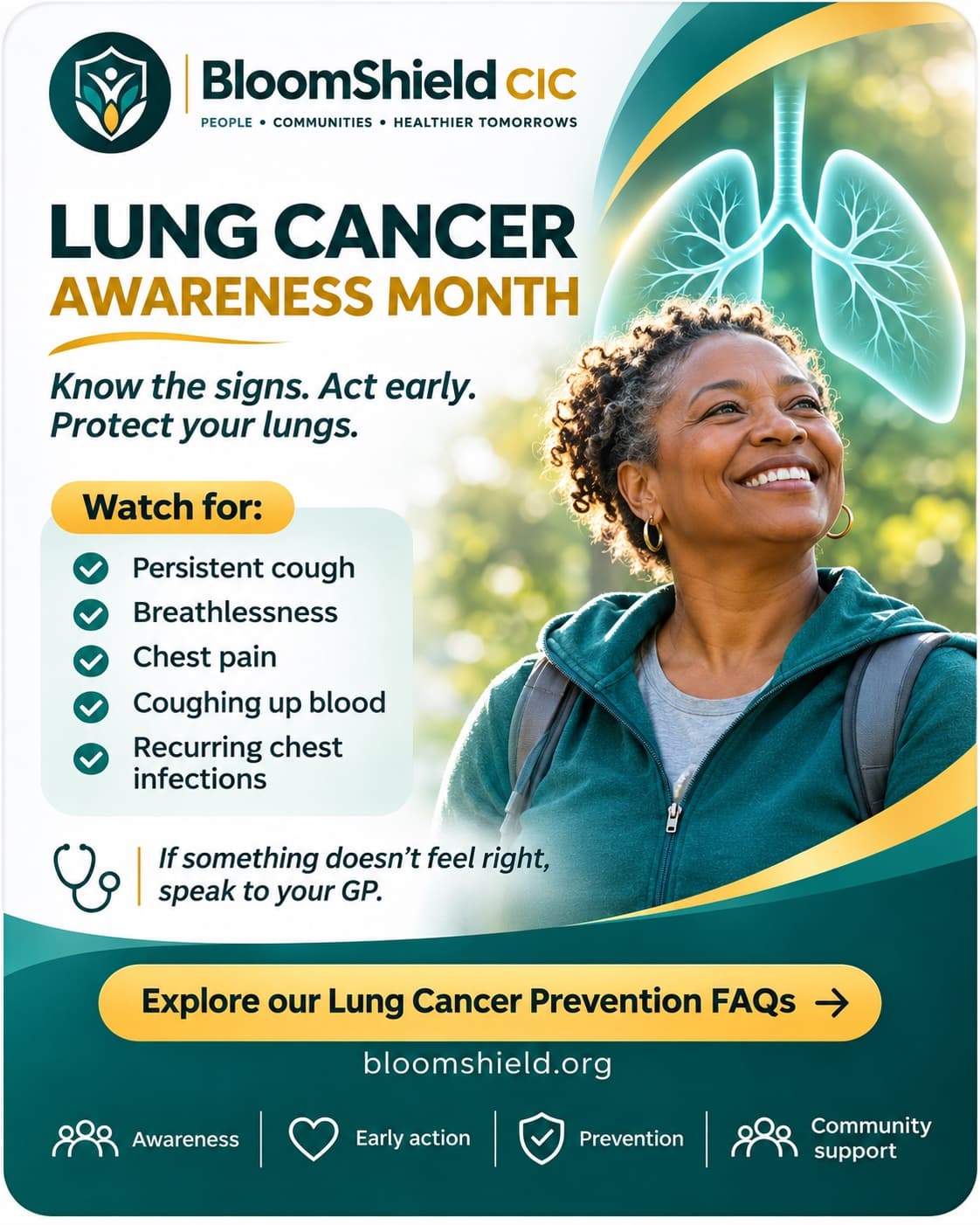
Know the Signs. Act Early.
Lung cancer does not always announce itself clearly.
Some people experience a persistent cough. Others notice increasing breathlessness, recurring chest infections or unexplained tiredness. Some have no noticeable symptoms during the early stages.
That is one reason awareness matters.
But recognising a possible symptom is only useful when it leads to the next step: seeking appropriate medical advice.
What symptoms should we recognise?
According to NHS guidance, possible symptoms of lung cancer include:
- A cough that does not go away, including one lasting more than three weeks
- A longstanding cough that changes or gets worse
- Persistent breathlessness
- Chest or shoulder pain
- Coughing up blood
- Chest infections that keep returning or do not improve
- Unexplained weight loss or loss of appetite
- Persistent tiredness
These symptoms do not necessarily mean someone has lung cancer. Many can have other explanations.
Nevertheless, persistent, worsening or concerning symptoms deserve medical assessment.
The message is not to assume the worst. It is not to ignore what may need attention.
Knowing when to act
The NHS recommends contacting a GP if you have a cough lasting longer than three weeks or other possible symptoms of lung cancer.
If you cough up blood, seek an urgent GP appointment or NHS 111 advice. If you cough up more than a few spots or streaks of blood, or cough up blood and find it hard to breathe, have a very fast heartbeat or have pain in your chest or upper back, call 999 or go to A&E immediately.
Severe difficulty breathing or other emergency warning signs require immediate help through 999 or A&E, in accordance with NHS guidance.
The practical message is straightforward:
Do not wait for a screening invitation if you are experiencing symptoms.
Clinical assessment of symptoms and routine screening are different routes into care.
Awareness must reach beyond the individual
People do not make health decisions in isolation.
Some may struggle to secure appointments. Others may be uncertain about symptoms, worried about a possible diagnosis, unable to communicate comfortably with services, or unsure where to seek help.
These are not simply individual knowledge gaps. They can also reflect barriers in how information, support and healthcare are delivered.
That is why awareness campaigns must consider accessibility, trust, communication and the circumstances in which people live.
An effective message should help someone understand what to do next — not simply tell them that lung cancer exists.
Recognition is only the beginning
Throughout November, BloomShield will examine the wider journey.
Our next feature will explore the NHS lung cancer screening offer in England: who may be eligible, how lung health assessments work, and why screening is offered to people at increased risk rather than everyone.
We will then consider barriers to participation and the importance of follow-up.
These questions are central to BloomShield's commitment to understanding why opportunities for earlier diagnosis do not always translate into equitable outcomes.
What you can do today
Be aware of changes in your respiratory health.
Do not dismiss persistent or concerning symptoms.
Seek appropriate medical advice rather than waiting for a screening invitation.
Share reliable information with family, friends and communities.
And remember: seeking medical advice does not mean you have cancer. It means giving yourself the opportunity to understand what may be happening.
Know the signs. Act early. Protect your lungs.
BloomShield CIC — Protect. Prevent. Empower.
How did this insight land with you?
Explore the campaign
References and source links
Contributor
About the author
BloomShield CIC
BloomShield CIC connects evidence, communities and implementation to advance equitable cancer prevention and earlier diagnosis.
Corrections, evidence or partnership follow-up
Suggest a correction, share relevant evidence or explore a partnership.
Cancer Care Partnership Ecosystem
CCPE Lens
This Insight is indexed through the domains most relevant to implementation and equitable impact.
Cross-cutting domains
- People
- Equity
- Impact