
Academic and research partners
Implementation science, AI evaluation, screening research, epidemiology, health economics and longitudinal pathway research.
Active development · Pillar 03
Intelligent Screening Registry & Navigation Research Demonstrator
A research-facing demonstrator exploring how cervical screening programmes can connect screening events, referral completion, follow-up, pathway outcomes and future AI evaluation within a longitudinal operational registry.
Synthetic research demonstrator · Not for clinical use
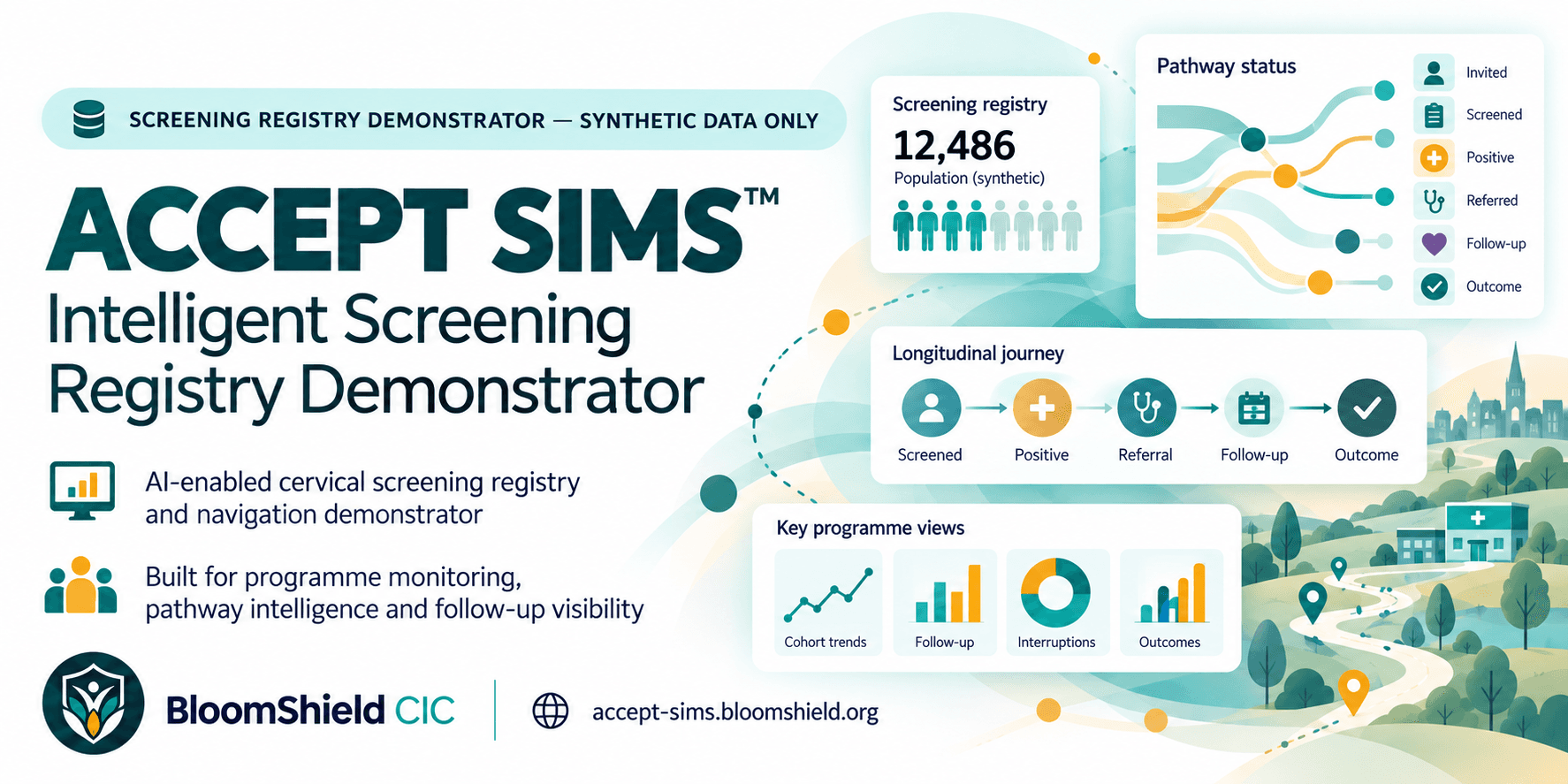 Explore the live ACCEPT SIMS™ stakeholder demonstrator →
Community screening programmes may record who was screened and the immediate result. Important implementation and research questions often begin after screening.
ACCEPT SIMS™ was built to make that pathway visible.
Traditional cancer registries are primarily important for epidemiology and population surveillance. ACCEPT SIMS™ explores a complementary role as an operational screening registry focused on the screening-to-resolution pathway.
It is intended to help research and implementation teams understand:
At scale, this type of infrastructure could support actionable intelligence for public-health institutions, academic partners, NGOs, implementation organisations and funders.
Build 001 · Synthetic data
The current Build 001 demonstrator uses 1,500 entirely synthetic participant records to explore screening and navigation information across a longitudinal pathway.
The demonstrator contains no real patient data and is not a clinical system. Its purpose is stakeholder review, research co-design and architecture exploration.
A referral records an intended next step; it does not establish that someone actually accessed care. Understanding the difference requires documenting the barriers along the pathway.
Capturing why care did not happen turns generic “lost to follow-up” into researchable and actionable pathway intelligence.
A pathway that cannot be completed should remain visible rather than disappearing from the dataset. Unresolved care describes a screening pathway that has not yet reached resolution.
Future research may explore supported re-engagement where new diagnostic capacity, transport assistance, subsidised care or other programme support becomes available.
Any real implementation would require appropriate consent, governance and clinical reassessment.
Future conceptual architecture
ACCEPT is an AI-enabled cervical cancer research programme, but ACCEPT SIMS™ is not intended to be a single AI model. Its architecture is model-agnostic, allowing future research to connect model outputs with human interpretation and the pathway that follows.
Future research could examine:
The research question is not only whether an AI model detects disease, but whether AI-enabled screening improves the pathway that follows detection.
Implementation science, AI evaluation, screening research, epidemiology, health economics and longitudinal pathway research.
Programme oversight, pathway intelligence, dataset development and screening-policy evaluation.
Participant tracking, referral follow-up, navigation and programme delivery.
Evaluation of whether screening interventions translate into completed pathways and measurable outcomes.
ACCEPT SIMS™ is being developed with the expectation that cervical screening research increasingly requires collaboration across academic institutions, implementation organisations, public-health agencies and technology partners.
The platform could support multi-site research questions including:
The long-term ambition is not to impose one screening model across African settings, but to provide a common research and information architecture that allows different programmes to generate comparable, governed and locally meaningful evidence.
BloomShield is actively exploring consortium-based research opportunities that could use ACCEPT SIMS™ as shared screening, navigation and evaluation infrastructure across African implementation settings.
Potential themes include:
We welcome discussions with universities, cancer institutes, public-health agencies, implementation organisations and research funders interested in developing collaborative proposals around these themes.
The current version is intended for research development and requirements discovery using synthetic data.
We are interested in collaborations around cervical cancer screening, implementation science, AI evaluation, patient navigation and longitudinal pathway research.