

Diagnosed — How Long Until Cancer Treatment Begins?
England is diagnosing more cancer earlier. But earlier diagnosis only delivers its full value if patients can move into treatment quickly enough.
By Dr Femi Olaleye
Global Health Specialist & Cancer Prevention Expert | Founder & CEO, BloomShield CIC
Published by BloomShield Insights
Last week, we asked whether England is catching more cancers earlier.
The latest national cancer data showed progress: more cancers are being diagnosed, and a greater proportion are being identified at stages 1 and 2.
But diagnosis is not the end of the pathway.
For patients, the next question is immediate:
How long until treatment begins?
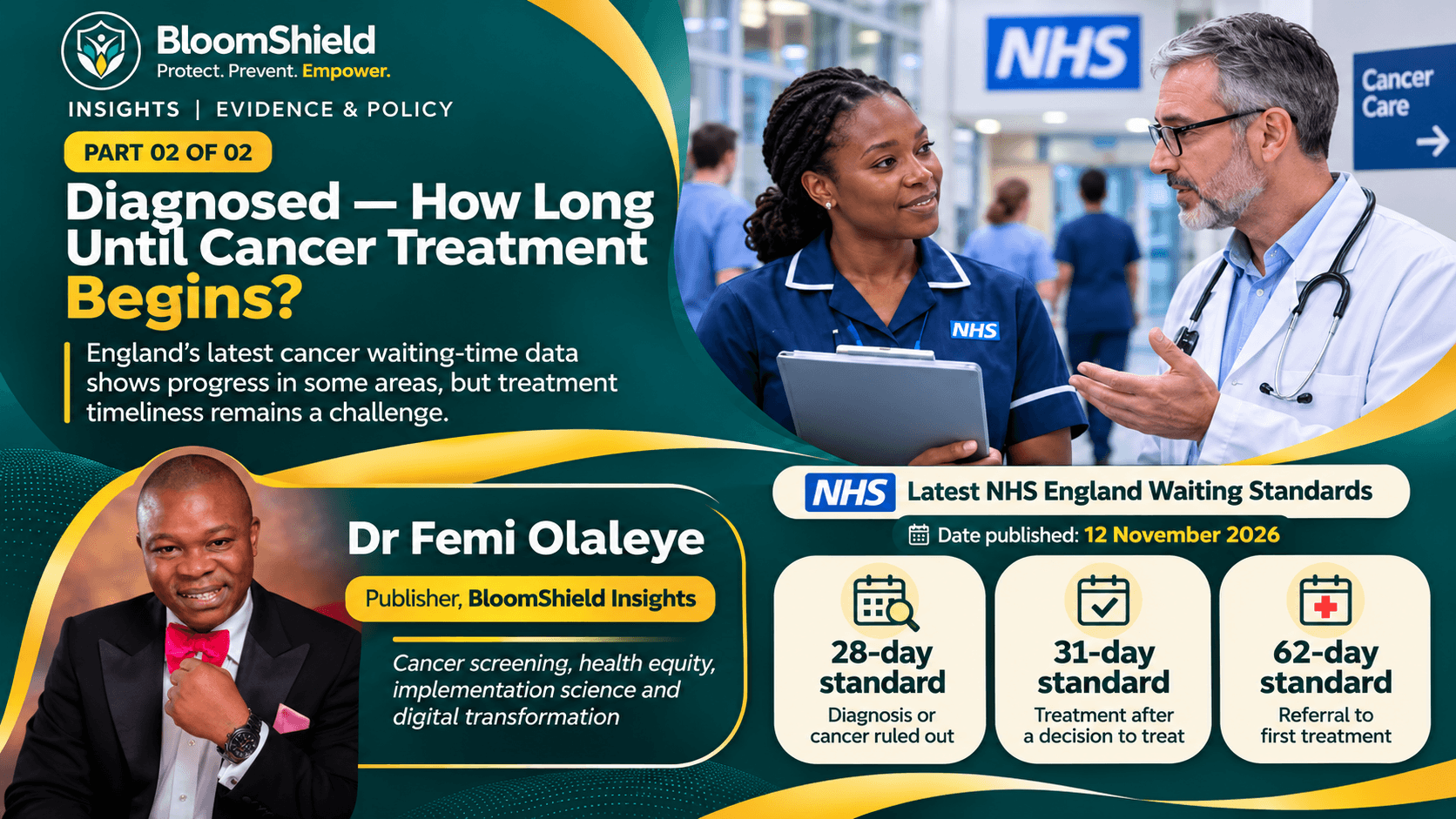
NHS England’s latest cancer waiting-time statistics, published on 12 November 2026, provide a useful snapshot of how that pathway is performing.
Three clocks — three different questions
England measures cancer waiting times through three principal standards.
The 28-day Faster Diagnosis Standard asks whether people urgently referred with suspected cancer or breast symptoms, or urgently referred from a screening programme, receive a diagnosis — or have cancer ruled out — within 28 days.
The 31-day standard measures the period from a decision to treat or earliest clinically appropriate date to the start of first or subsequent treatment. The target is 96%.
The 62-day standard measures the broader pathway from urgent suspected cancer, breast symptomatic or screening referral, or consultant upgrade, to first definitive treatment.
That distinction matters.
None of these is simply a national “diagnosis-to-treatment” clock.
Together, however, they show how efficiently patients move through different parts of the cancer pathway.
September shows continuing pressure
In September 2026, 76.2% of urgently referred patients received a diagnosis or had cancer ruled out within 28 days.
That was down from 78.6% in August and remained below the 80% standard.
The treatment picture was also challenging.
91.5% began first or subsequent treatment within 31 days, below the 96% target.
Only 70.7% of patients began first definitive treatment within 62 days of an urgent referral or consultant upgrade — down from 71.9% in August and well below the 85% standard.
The direction matters because this is not simply about administrative performance.
Behind each percentage is someone waiting to know what happens next.
The diagnosis figure hides an important difference
The overall 28-day figure also needs unpacking.
For July to September 2026, 79.5% of people who ultimately had cancer ruled out received that result within 28 days.
Among people who were actually diagnosed with cancer, however, only 56.2% received their diagnosis within that period.
That gap matters.
The people who ultimately need treatment are also the group experiencing the slower diagnostic pathway.
Earlier diagnosis remains one of the most important opportunities in cancer care.
But identifying disease earlier only creates an opportunity.
The system still has to convert that opportunity into timely treatment.
Earlier diagnosis is only part of the pathway
Cancer pathways are connected.
Referral → investigation → diagnosis → treatment planning → treatment
A delay at one stage can affect what follows.
And national averages can conceal substantial variation between cancers, hospitals, regions and communities.
This is why pathway performance should not be judged only by whether a referral was made or a diagnosis reached.
We also need to ask:
Did the patient move through the rest of the pathway without avoidable delay?
That is an implementation question as much as a clinical one.
Progress should be recognised — but so should the gap
England has made genuine progress in identifying more cancers and diagnosing more disease at an earlier stage.
That deserves recognition.
But the latest waiting-time results show that the pathway after referral remains under pressure.
The 28-day standard was missed in September.
The 62-day standard was missed by a substantial margin.
And the diagnostic experience of people ultimately found to have cancer remains markedly worse than the headline Faster Diagnosis figure suggests.
The lesson is not that earlier diagnosis is failing.
Earlier diagnosis is meaningful only if the rest of the pathway can keep pace.
Because detecting cancer sooner matters.
But what happens next matters too.
References
- September 2026 cancer waiting times: provider-based statistical releaseNHS England · 12 November 2026
- Waiting times for suspected and diagnosed cancer patients for September 2026 and Q2 2026/27NHS England · 12 November 2026
- Waiting times stall on diagnosis for people with cancerCancer Research UK · 12 November 2026
- Faster Diagnosis Standard performance by referral outcomeCancer Research UK · November 2026 data brief
Contributor
About the author
Dr Femi Olaleye
Global Health Specialist & Cancer Prevention Expert
Founder & CEO, BloomShield CIC
Dr Femi Olaleye is a global health specialist and cancer prevention expert, and the founder of BloomShield CIC. His work focuses on equitable cancer prevention, screening access, implementation, community engagement and partnerships that translate evidence into practical improvements in cancer care.
How did this insight land with you?
Corrections, evidence or partnership follow-up
Suggest a correction, share relevant evidence or explore a partnership.
Cancer Care Partnership Ecosystem
CCPE Lens
This Insight is indexed through the domains most relevant to implementation and equitable impact.
Cross-cutting domains
- People
- Systems
- Equity
- Impact