
ScreenConnect Digital™: From Concept to Working Research Demonstrator
Beyond screening uptake. Understanding the journey. Exploring what happens next.
By Dr Femi Olaleye
MB.ChB MBA | Founder & CEO, BloomShield CIC
Published by BloomShield CIC
844 potentially missed cervical precancerous lesions. What happened along the screening journey?
In 2024, researchers examining the Dutch national HPV-based cervical cancer screening programme published a finding that deserves attention.
Their study included more than 840,000 women.
Among women lost to follow-up at different stages of the screening pathway, researchers estimated 844 potentially missed high-grade cervical lesions (CIN2+).
Of those, an estimated 462 occurred among women who had been advised to undergo colposcopy.
These were estimates, not confirmed diagnoses among the women lost to follow-up.
840,000+
Women studied
844
Estimated potentially missed CIN2+ lesions
462
Estimated following colposcopy referral advice
Missed lesions were estimated, not confirmed among women lost to follow-up.
But the implications were significant.
A woman can participate in screening, receive an abnormal result, be advised to undergo further investigation — and still not complete the next stage of care.
The challenge is not always getting someone into screening.
Sometimes, it is what happens afterwards.
A completed screening test does not necessarily mean a completed screening journey.
That observation captures one of the central questions behind an innovation we have been developing at BloomShield.
From identifying the gap to understanding the journey
Throughout October, our Breast Cancer Awareness Month series explored screening inequalities, while BloomShield Local Lens examined how different communities across England are responding.
From mobile screening in Liverpool to pathway adaptation in Greater Manchester and proactive identification of non-responders in Havering, we have encountered a recurring implementation challenge.
Who needed support? What barrier appeared? What intervention followed? And what happened next?
Population intelligence can help identify where screening inequalities exist.
But understanding the individual journey requires looking beyond the screening event itself.
That is the thinking behind our 360° cancer screening journey.
And it brings us to an important milestone.
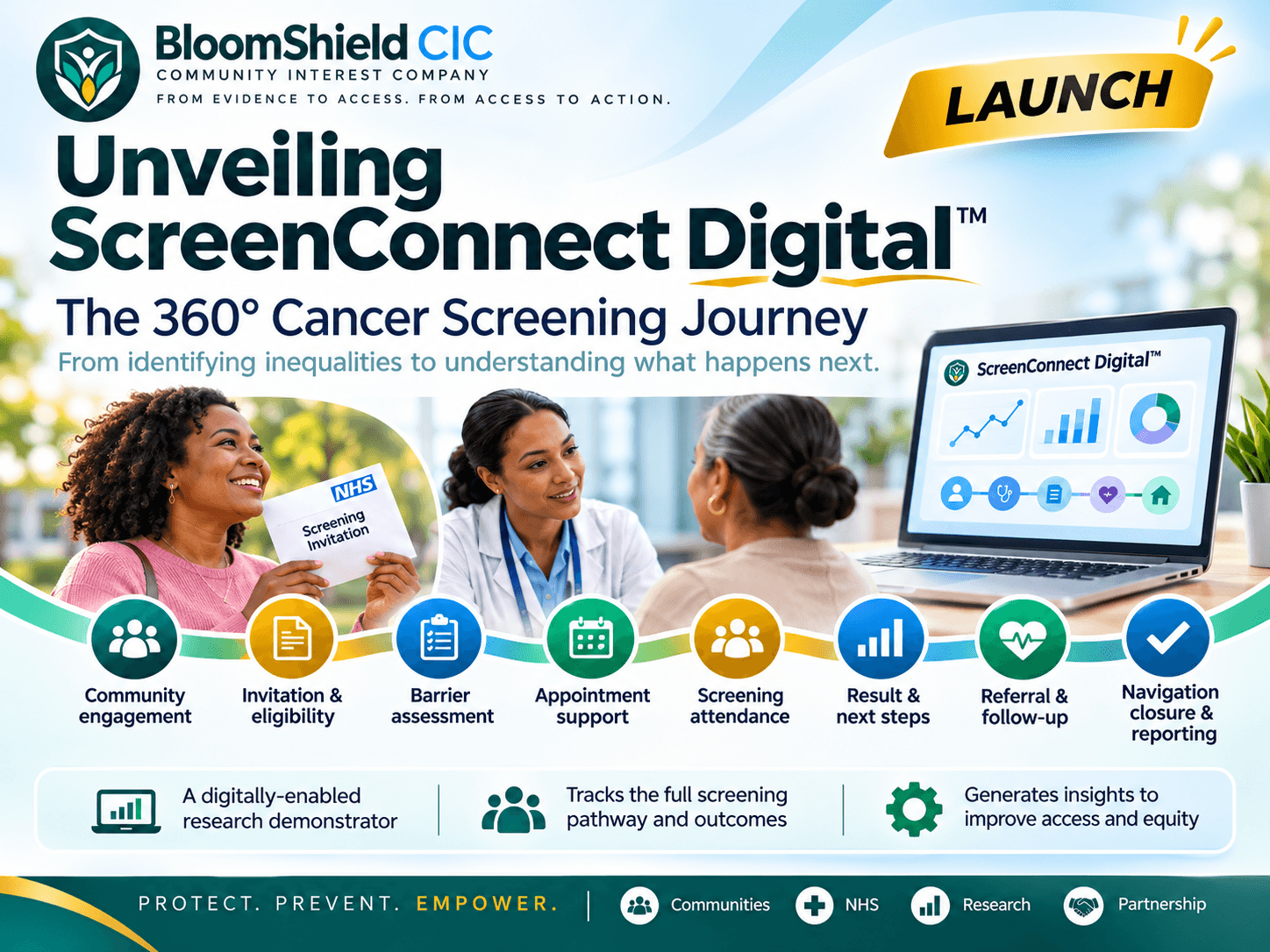
Introducing ScreenConnect Digital™
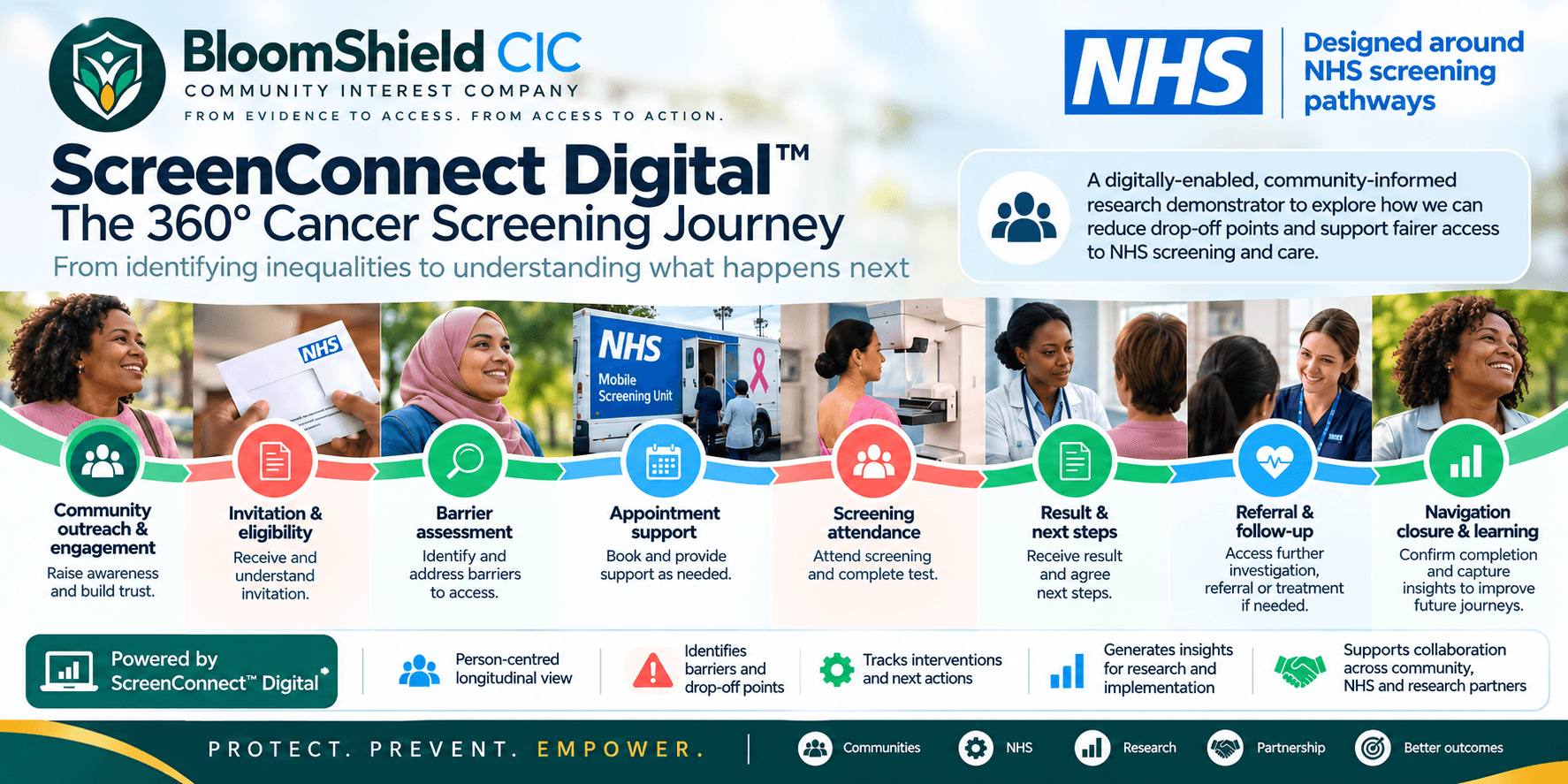
ScreenConnect Digital™ is BloomShield's working, synthetic-data research demonstrator for exploring person-centred, longitudinal screening journeys, pathway continuity and implementation outcomes.
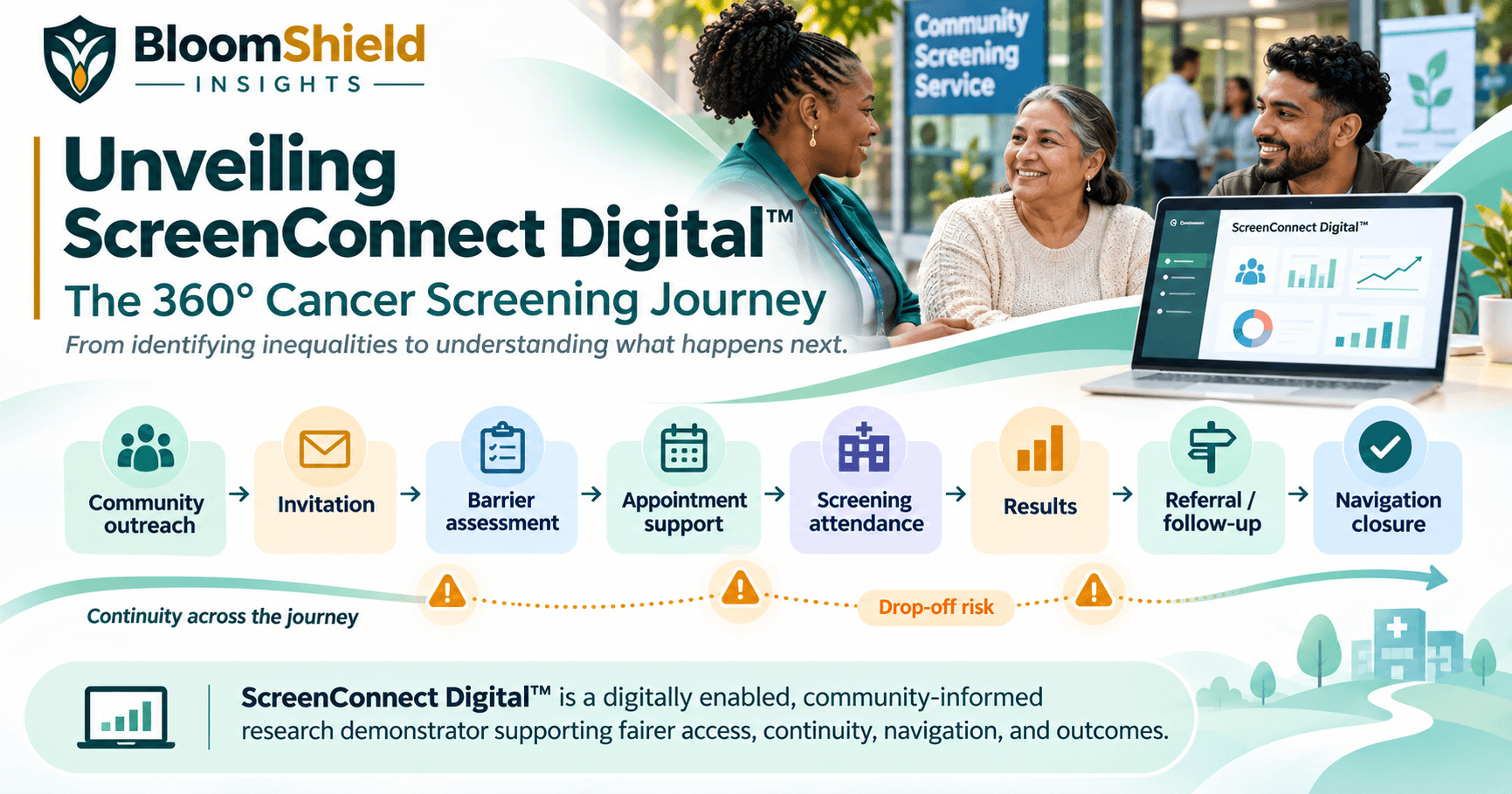
The original concept emerged from a practical problem: the gap between community engagement, screening participation, navigation, referral and subsequent care.
We wanted to explore whether those different stages could be understood as a connected journey rather than a collection of isolated events.
In September 2026, the proposition entered the NHS Innovation Service needs-assessment process, helping frame questions for further discovery and evaluation.
We subsequently progressed from concept to a working research demonstrator, completing its initial technical build and validation against its defined development requirements.
The result is a synthetic-data environment for examining pathways, barriers, interventions, next actions and outcomes.
At the centre of the model is a simple sequence:
- Person
- Pathway
- Barrier
- Intervention
- Next Action
- Outcome
- Learning
This is what we mean by the 360° journey.
Not simply whether someone attended screening.
But what happened before, during and after that encounter — and what might help the journey continue.
One research approach. Multiple screening pathways.
ScreenConnect Digital™ explores questions across breast, cervical, bowel and lung cancer screening, alongside NHS Health Check pathways.
The demonstrator brings together synthetic participant journeys, pathway events, barriers, intervention records and research views in one exploratory environment.
It offers a way to investigate recurring implementation questions:
- Where do screening journeys stall?
- What barriers are documented?
- What support or navigation intervention follows?
- What happens at referral and follow-up?
- How might these patterns be studied across different population groups?
The opportunity is not simply to produce another dashboard.
It is to investigate the journey inside the population-level gap.
Our working demonstrator establishes a foundation for this research. Its usefulness in real clinical and community settings remains a question for future collaborative evaluation.
From development to research collaboration
We have reached a stage where ScreenConnect Digital™ needs more than internal development.
It needs the perspectives of people who understand the real pathways.
We welcome conversations with epidemiologists, behavioral scientists, implementation researchers, NHS screening teams, Cancer Alliances, community organisations, digital-health specialists and prospective end users.
We are interested in collaborative review of the research model, pathway assumptions, user requirements, feasibility and future evaluation opportunities.
The aim is not to present a finished solution.
It is to develop and test a promising research approach with the people best placed to challenge and improve it.
The next phase is discovery, collaboration and evidence-building.
The journey continues
The Dutch study offers a powerful reminder of why continuity matters.
Our Local Lens research is demonstrating how inequalities, investments and implementation responses differ across communities.
And ScreenConnect Digital™ represents BloomShield's attempt to bring these questions into a working research environment.
We have moved from concept to demonstrator.
Now we want to learn what it can genuinely contribute.
Because a screening gap is not just a number. It is a journey that stopped somewhere.
The question is whether we can understand where, why — and what should happen next.
Explore ScreenConnect Digital™
Learn more about the demonstrator and our research direction:
Explore ScreenConnect Digital™ →
BloomShield CIC
Protect. Prevent. Empower.
How did this insight land with you?
References and source links
- Olthof EMG et al. — The impact of loss to follow-up in the Dutch organised HPV-based cervical cancer screening programme.International Journal of Cancer, 2024. Women studied: 840,428. Potentially missed CIN2+ lesions are estimates, including 462 after direct referral advice for colposcopy.
Contributor
About the author
Dr Femi Olaleye
MB.ChB MBA
Founder & CEO, BloomShield CIC
Dr Femi Olaleye is a global health specialist and cancer prevention expert, and the founder of BloomShield CIC. His work focuses on equitable cancer prevention, screening access, implementation, community engagement and partnerships that translate evidence into practical improvements in cancer care.
Corrections, evidence or partnership follow-up
Suggest a correction, share relevant evidence or explore a partnership.
Cancer Care Partnership Ecosystem
CCPE Lens
This Insight is indexed through the domains most relevant to implementation and equitable impact.
Cross-cutting domains
- People
- Systems
- Innovation
- Equity
- Impact