
Local Lens: Greater Manchester
What happens when the screening pathway adapts to the person?
Greater Manchester is showing that screening inequalities are not fixed — and that targeted, personalised support can change participation and pathway outcomes.
By Dr Femi Olaleye
Global Health Specialist & Cancer Prevention Expert | Founder & CEO, BloomShield CIC
7 min read
Published by BloomShield Insights
DID YOU KNOW?
Greater Manchester’s work on cancer inequalities sits within substantial NHS investment in earlier diagnosis and system improvement.
Through NHS England’s Cancer Alliance programme, Greater Manchester received around £13.6 million in 2023/24 and a further £13.6 million in 2024/25 — alongside separately funded national programmes including targeted lung screening.
That investment has supported a wider programme spanning screening, earlier diagnosis, pathway redesign, primary care, community engagement, data and innovation.
And there are signs of movement.
Greater Manchester reported that cancers diagnosed at stage 1 or 2 increased from 53.2% in August 2021 to 58.3% by July 2024, later reaching 60.2% across February 2024 to January 2025.
But the most interesting story may sit underneath the system-wide numbers.
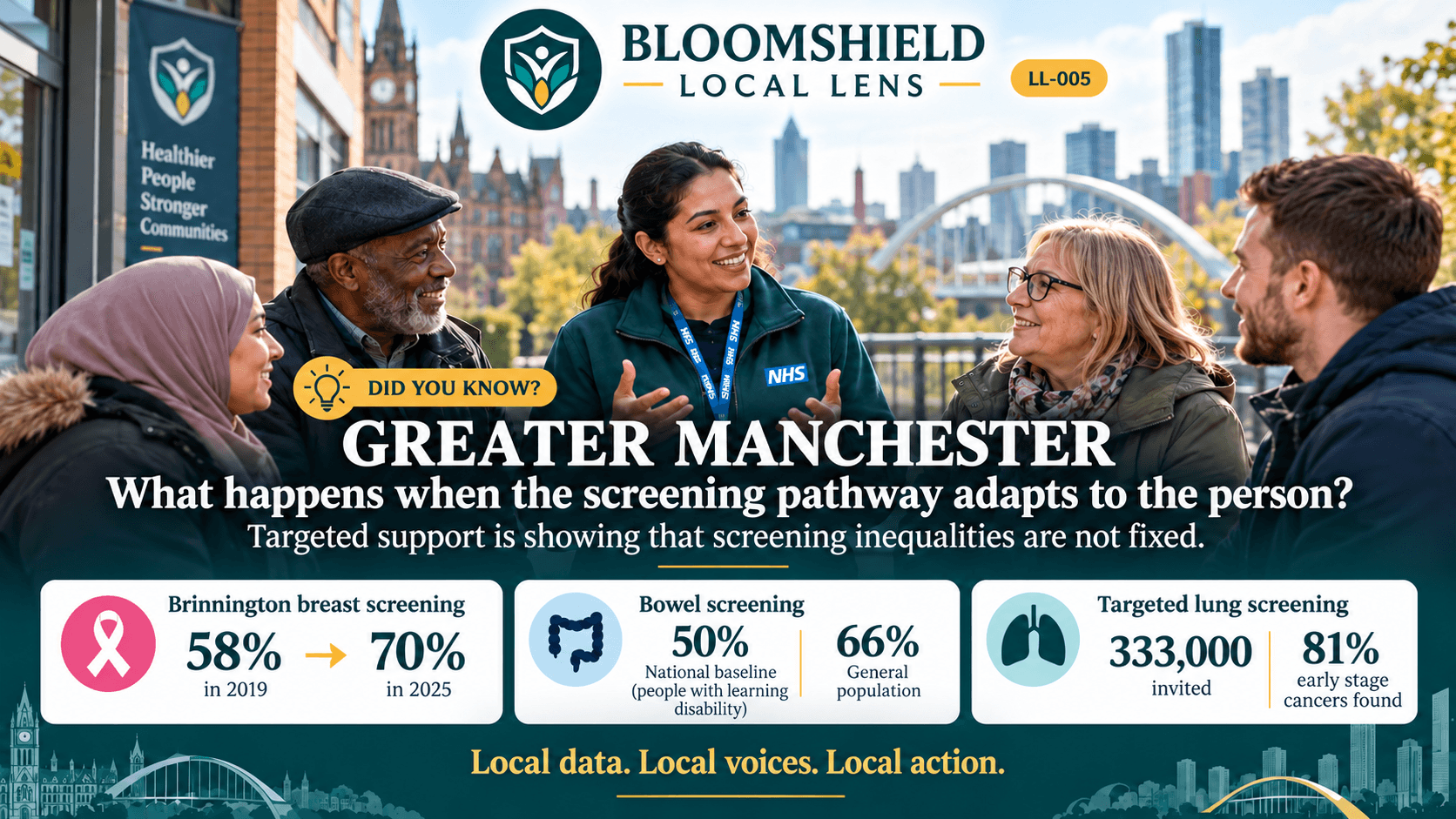
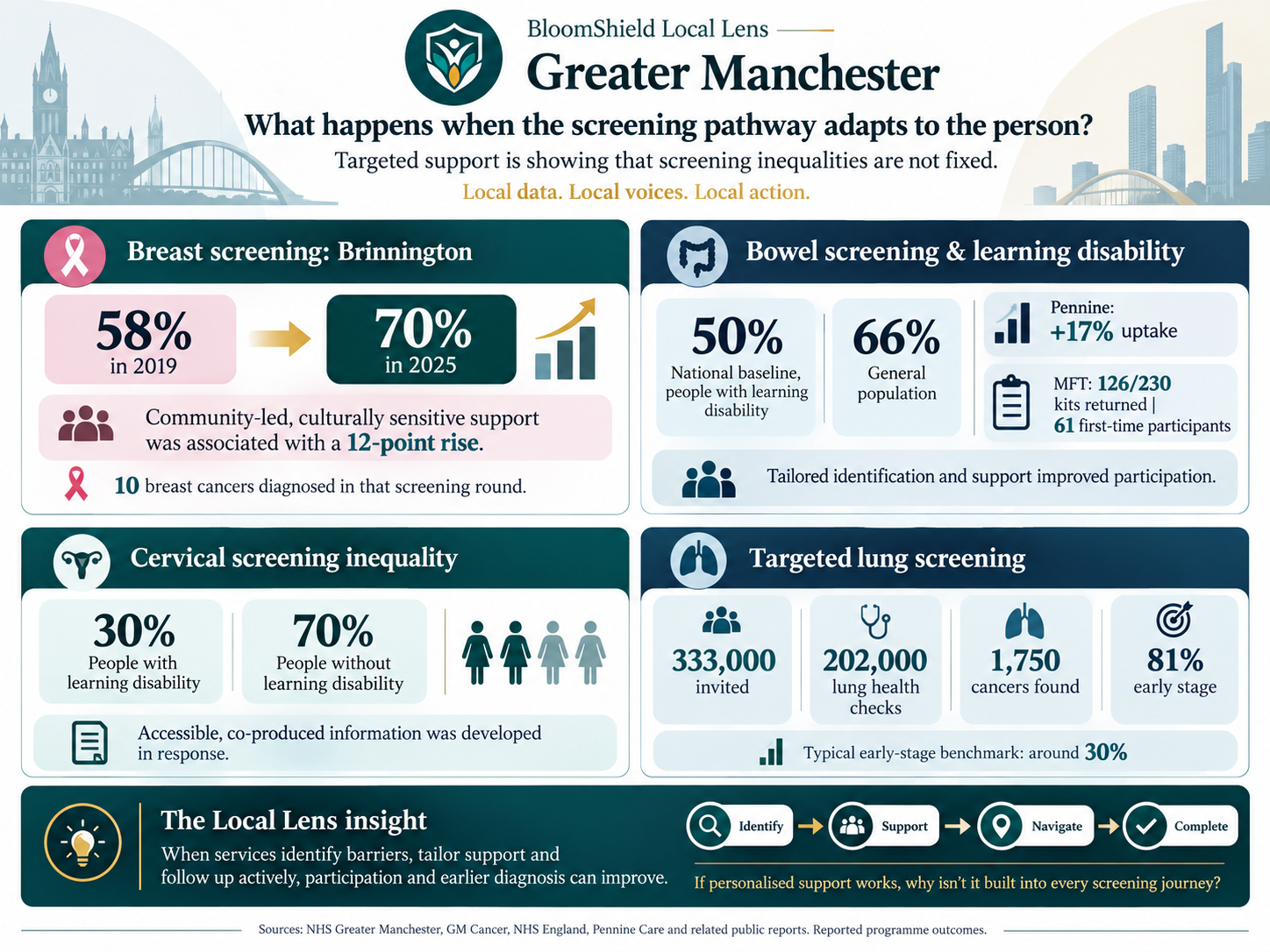
In Brinnington, one of Stockport’s most deprived communities, breast screening uptake increased from 58% in 2019 to 70% in 2025.
The intervention brought together breast screening services, GP practices, Public Health and community organisations, using public-health intelligence, culturally sensitive support, multilingual conversations, drop-ins and local champions.
Ten breast cancers were diagnosed during that screening round.
That raises an important question:
What happens when the screening pathway adapts to the person — rather than expecting the person to adapt to the pathway?
The inequalities are real
Greater Manchester’s own data shows why adaptation matters.
For bowel cancer screening, national figures cited by NHS Greater Manchester show that in 2022/23, 50% of people with a learning disability completed colorectal cancer screening, compared with 66% of the general population.
For cervical screening, the gap is even wider.
A Greater Manchester project reported screening uptake of 30% among people with a learning disability, compared with 70% among people without one.
Local population-health intelligence has also shown substantial variation by ethnicity, with lower breast screening coverage among some minority ethnic groups in parts of Greater Manchester.
These are not small differences.
And they are unlikely to be explained by one barrier.
Sometimes the pathway itself needs to change
Greater Manchester’s response to bowel screening among people with learning disabilities is instructive.
Rather than simply sending another reminder, the system introduced a learning-disability flagging programme.
People who had not previously returned a FIT kit were identified.
Pre-notification lists were shared with cancer screening improvement leads.
Community learning-disability teams became involved.
Tailored education and practical support were offered.
The purpose was straightforward: identify people who had not previously participated and support them to complete screening successfully.
That is a very different model from passive invitation.
It is:
Identify → understand need → support → follow up → complete.
And the logic extends beyond the first screening test.
Greater Manchester has also identified difficulties further along the bowel pathway, particularly when someone receives an abnormal result and needs a colonoscopy.
In response, local teams developed accessible journey films showing what happens next and the reasonable adjustments that can be made.
The important point is that the gap can occur anywhere.
Not just before attendance.
But between:
screening → abnormal result → investigation → completion.
Accessible information can be an intervention
The cervical screening work makes the same point in another way.
Autistic women and women with learning disabilities helped co-produce accessible films explaining cervical screening, HPV vaccination, preparation, what happens during the test and what happens afterwards.
The intervention was not designed only around what professionals thought people needed.
It was designed with people who had lived experience of the barriers themselves.
That matters.
Because sometimes the problem is not unwillingness.
It is anxiety.
Uncertainty.
Communication.
Previous experience.
Or a pathway that assumes everyone receives and processes information in the same way.
Targeted screening can also change when cancer is found
Greater Manchester’s lung cancer programme shows what targeted approaches can achieve at scale.
More than 333,000 people have been invited for a lung health check.
Around 202,000 checks have been completed.
More than 1,750 lung cancers have been detected through the programme.
And 81% were diagnosed at an early stage.
Across Greater Manchester more broadly, the proportion of cancers diagnosed at an early stage has also improved in recent years.
No single intervention explains that improvement.
But the direction is important.
Targeting.
Community engagement.
Primary-care education.
Accessible information.
Pathway redesign.
Screening closer to people.
These things can change outcomes.
The lesson may be simpler than it looks
Greater Manchester is not telling us that one intervention will solve screening inequality.
It is telling us something more useful.
Different barriers require different responses.
A woman in Brinnington may need trusted community engagement.
A person with a learning disability may need accessible information and practical support.
A high-risk smoker may benefit from targeted outreach and a lung health check.
Someone with an abnormal bowel screening result may need reassurance and reasonable adjustments before colonoscopy.
The common thread is not the disease.
It is the pathway adapting to the person.
From targeted projects to routine practice
Greater Manchester is showing that screening inequalities can shift when the system does more than invite.
The strongest examples have several things in common:
someone is identified,
a barrier is recognised,
support is adapted,
follow-up happens,
and the outcome is measured.
That is more than outreach.
It is a different way of thinking about the screening journey.
Instead of asking only:
Did this person attend?
we begin to ask:
What got in the way?
What support was offered?
What happened next?
And did the person ultimately complete the pathway?
That is where the implementation challenge becomes much more interesting.
Because if personalised support works, the next question is not simply whether individual projects should continue.
It is:
How do we make barrier-aware, person-centred support part of the pathway itself?
For BloomShield, that is the question we are increasingly focused on.
Our work is moving beyond identifying where screening gaps exist towards understanding how people move through those gaps over time — and what kinds of intervention help them move forward.
Greater Manchester gives us a practical glimpse of what that can look like.
Identify → understand → adapt → support → follow up → complete.
The opportunity now is to make that logic easier to apply, easier to evaluate and easier to scale.
That is where implementation science has to move next.
Local data. Local voices. Local action.
How did this insight land with you?
References and source links
- Greater Manchester Cancer Board: Cancer Alliance funding, January 2023Greater Manchester Cancer Board · Cancer Alliance Allocation 2023–24/2024–25, pp. 70–72: £13,607,311 for 2023/24 and £13,582,543 for 2024/25 in place-based service development funding, alongside separately funded targeted programmes.
- Joint Forward PlanNHS Greater Manchester · Wider cancer-system priorities and earlier diagnosis.
- Early Cancer Diagnosis Strategy 2024–28Greater Manchester Cancer Alliance · Early diagnosis, inequalities and system improvement.
- Brinnington breast screening partnership case studyGreater Manchester Cancer Alliance / Stockport Council · Reported uptake increased from 58% in 2019 to 70% in 2025; 10 cancers diagnosed in that screening round.
- Learning-disability bowel screening programmeNHS Greater Manchester · National 2022/23 baseline and tailored FIT-kit support through the flagging programme.
- Accessible cervical screening filmsPennine Care NHS Foundation Trust · Co-produced films with autistic women and women with learning disabilities.
- Lung screening programme outcomesGreater Manchester Cancer Alliance · Invitations, completed checks and cancers detected; 81% early-stage diagnosis within the screening programme.
- Early cancer diagnosis in Greater ManchesterGreater Manchester Cancer Alliance · 60.2% early diagnosis across February 2024–January 2025, within a wider programme of system improvement.
- Cancer screening population-health intelligenceNHS Greater Manchester · Coverage and population variation across screening programmes.
Contributor
About the author
Dr Femi Olaleye
Global Health Specialist & Cancer Prevention Expert
Founder & CEO, BloomShield CIC
Dr Femi Olaleye is a global health specialist and cancer prevention expert, and the founder of BloomShield CIC. His work focuses on equitable cancer prevention, screening access, implementation, community engagement and partnerships that translate evidence into practical improvements in cancer care.
Corrections, evidence or partnership follow-up
Suggest a correction, share relevant evidence or explore a partnership.
Cancer Care Partnership Ecosystem
CCPE Lens
- Understand
- Validate
- Implement
- Evaluate
This Insight is indexed through the domains most relevant to implementation and equitable impact.
Cross-cutting domains
- People
- Partnerships
- Systems
- Equity
- Impact
Continue exploring