South Yorkshire's Cancer Screening Gap: The Last Mile Between Invitation and Action
Cancer screening saves lives, but an invitation is not the same as participation.
By BloomShield CIC
5 min read
Published by BloomShield Insights
Across South Yorkshire and Bassetlaw, recent evidence shows how far the gap can remain between offering preventive healthcare and enabling people to use it.
The challenge is not simply whether screening programmes exist. It is whether people can understand, trust and act on the opportunities available to them.
What the evidence tells us
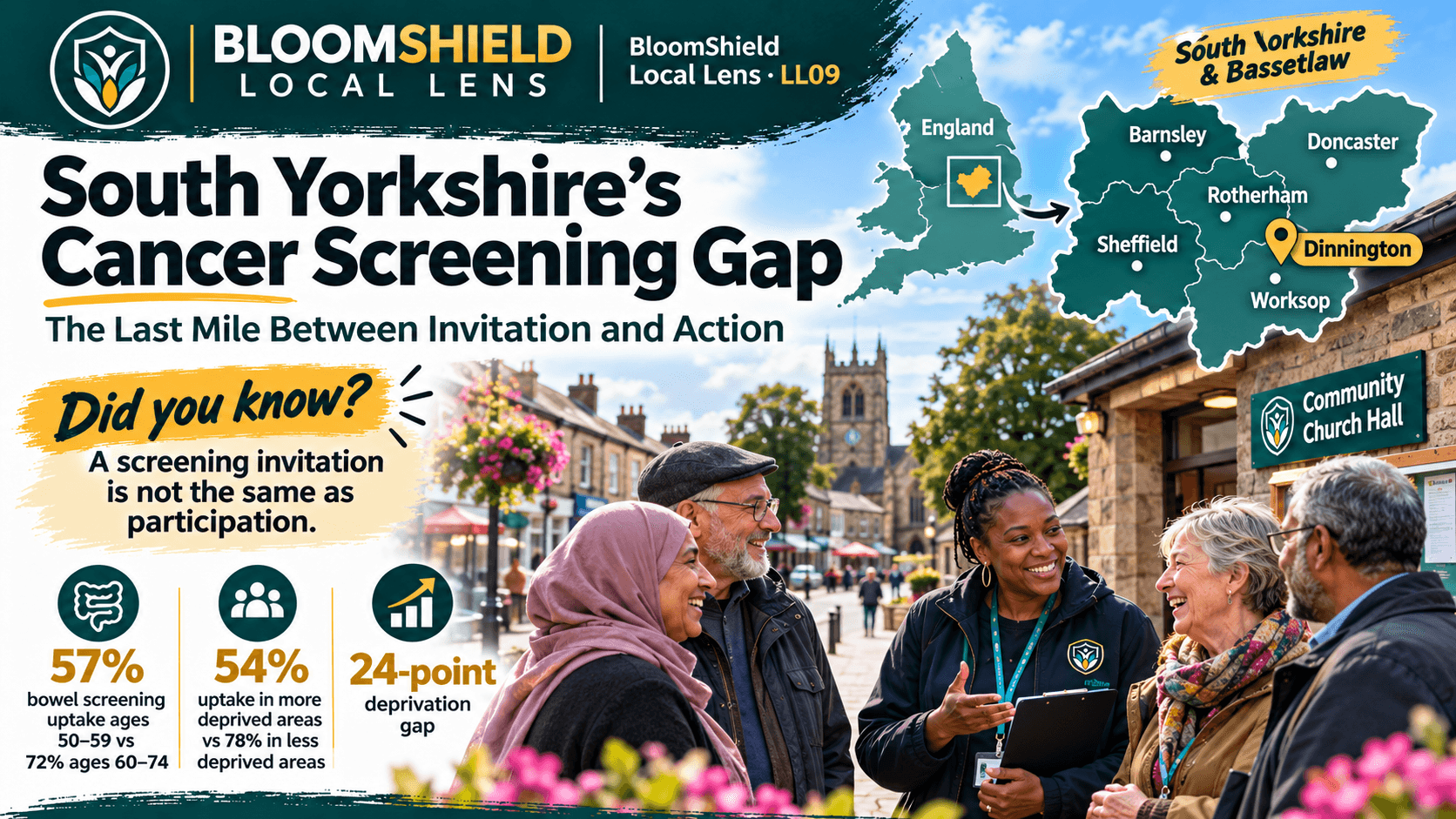
In October 2025, the South Yorkshire and Bassetlaw Cancer Alliance reported marked inequalities in bowel cancer screening uptake.
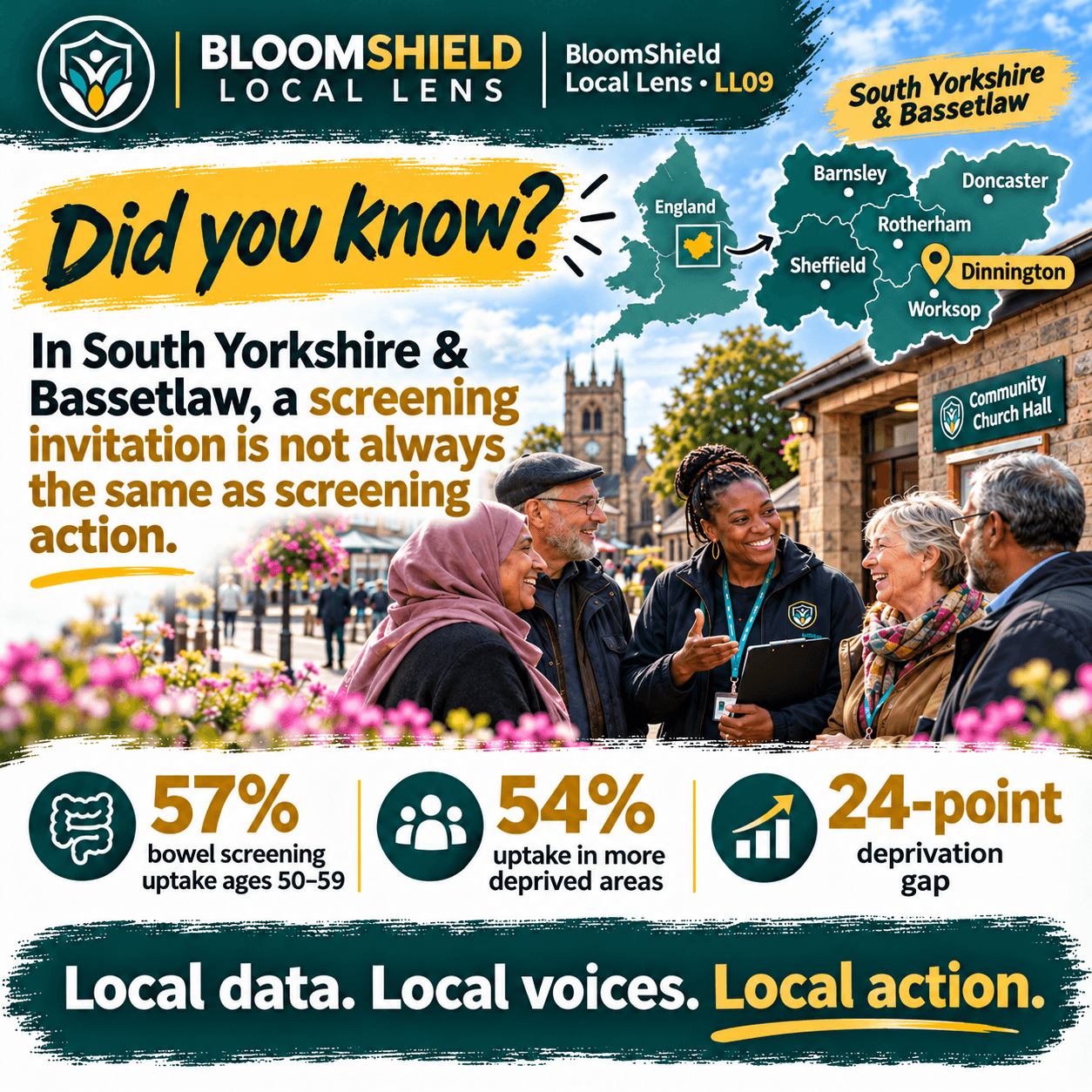
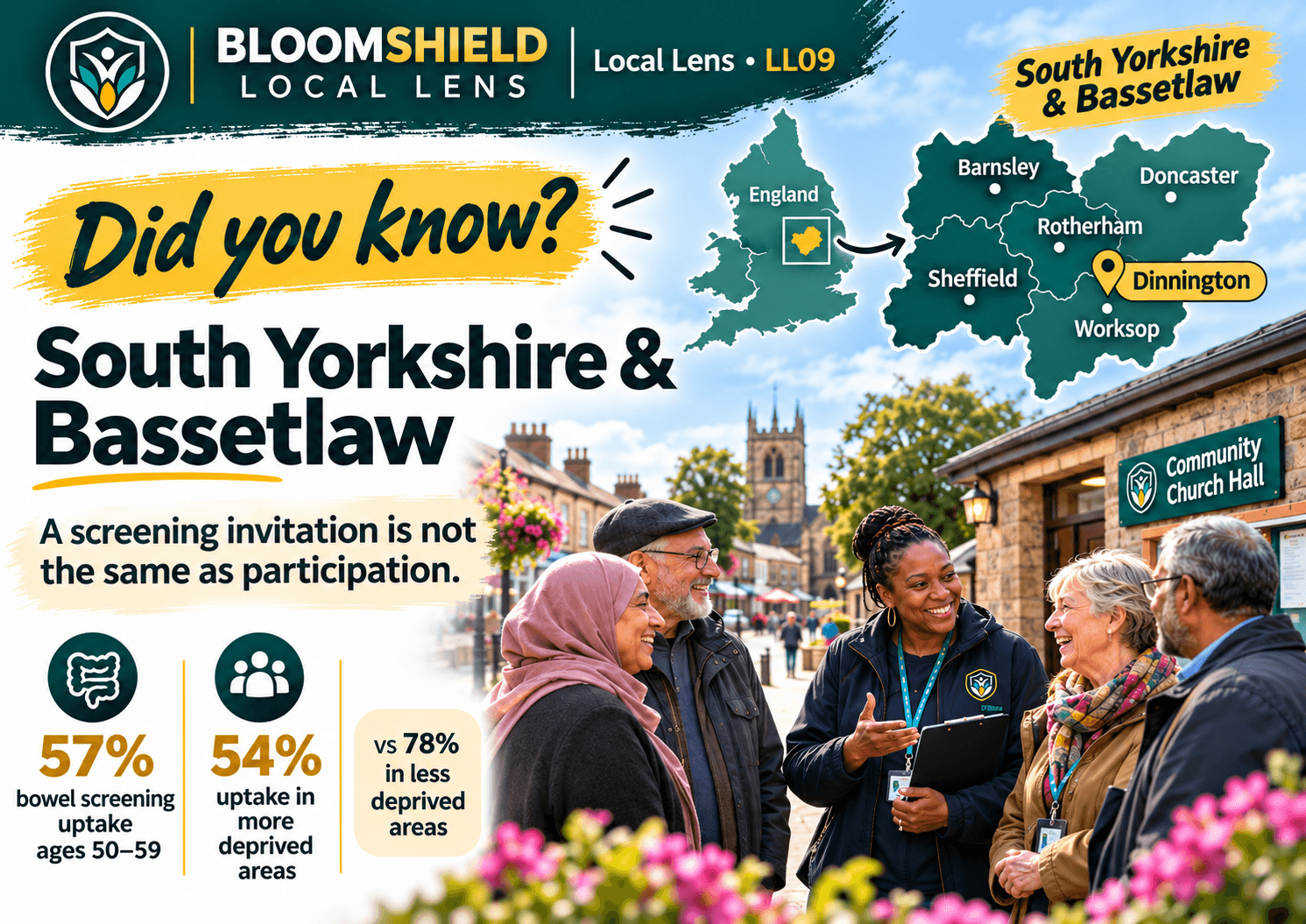
Participation among adults aged 50–59 was 57%, compared with 72% among those aged 60–74.
The deprivation gap was wider still: uptake was 54% in more deprived communities, compared with 78% in less deprived communities.
That is a 24-percentage-point gap.
These are regional figures, not Dinnington-specific estimates. But they illustrate why universal invitations do not automatically produce equitable participation.
Dinnington itself has a mixed socioeconomic profile. Rotherham Council data identify Dinnington Central and Dinnington East among England's most deprived 10% of neighbourhoods, while other parts of the ward are considerably less deprived.
That variation matters. Community interventions must respond to differences within places, not assume everyone in one postcode faces the same barriers.
What the Cancer Alliance is already doing
The South Yorkshire, Bassetlaw and North Derbyshire Cancer Alliance has developed several approaches to prevention, screening and earlier diagnosis.
Its Cancer Champion Programme supports primary-care teams seeking to improve screening participation and address inequalities, drawing on local data, communication resources and behavioural approaches.
Be Cancer SAFE works with voluntary-sector and healthcare organisations, including Voluntary Action Rotherham, to bring cancer-awareness conversations into community settings.
The Alliance's Peace of Mind campaign encourages people experiencing possible cancer symptoms to contact their GP rather than delay seeking advice.
The region has also made substantial progress in lung cancer screening. By February 2026, around 178,000 people had been invited, nearly 79,000 had undergone a Lung Health Check, and 666 lung cancers had been identified, with 77% detected at an early stage.
That shows what organised screening can achieve when invitation is converted into participation.
Where the last-mile challenge remains
Non-participation rarely has one explanation.
Barriers may include embarrassment, uncertainty, language, competing responsibilities, practical difficulties or limited confidence in healthcare services.
A bowel screening kit may arrive and never be returned.
Someone may understand the purpose of cervical screening but struggle to attend.
A person experiencing unexplained symptoms may postpone contacting their GP.
Information campaigns matter, but some barriers require continuing conversations, practical navigation and trusted relationships.
This is the last mile between invitation and action.
The potential role of faith and community organisations
Trusted local organisations can provide regular contact with families and opportunities for culturally sensitive health conversations.
Faith organisations are not substitutes for NHS services, and faith leaders should not provide clinical advice.
Their contribution is different: helping people understand reliable information, addressing misconceptions, encouraging appropriate action and directing people towards NHS services.
A trained Community Champion might help someone find NHS guidance on completing a bowel screening kit, explain where screening information is available, or encourage someone with concerning symptoms to seek medical advice.
Importantly, community activity should remain open beyond congregation members and accessible regardless of faith or background.
From awareness to measurable action
Community engagement should not be judged only by event attendance or leaflets distributed.
A stronger approach asks:
- How many screening-eligible people engaged?
- What barriers were identified?
- What navigation or signposting support was provided?
- How many people reported taking appropriate action?
These measures help distinguish communication activity from meaningful movement towards participation.
The Cancer Alliance's September 2026 update also highlighted future priorities around neighbourhood approaches and stronger community-based care.
That creates space for complementary, locally designed partnerships.
The wider lesson
South Yorkshire's experience illustrates a simple but important principle:
The effectiveness of screening depends not only on who is invited, but also on who is supported to respond.
Clinical programmes, local intelligence, community organisations and trusted relationships each bring different strengths.
Connecting them effectively may help turn screening availability into participation — and participation into earlier diagnosis.
Local data. Local voices. Local action.
BloomShield Local Lens provides independent, evidence-led analysis of cancer prevention, screening inequalities and opportunities for community-based health improvement. This article is not commissioned by or affiliated with the Cancer Alliance or Weston Park Cancer Charity.
Sources
- Make your 'Number Two' your Number One priority!30 October 2025. Regional bowel screening participation by age and deprivation.
- Rotherham Council — Dinnington Ward ProfileRefreshed February 2024. Local deprivation and variation within the ward.
- Cancer Champion ProgrammePrimary-care support, local screening data, communication and behavioural resources.
- Be Cancer SAFECommunity cancer awareness and voluntary-sector delivery, including Voluntary Action Rotherham.
- Peace of Mind campaignEncouraging people with possible cancer symptoms to contact their GP promptly.
- Life-saving screening for lung cancer — 100% rollout across the region2 February 2026. Regional invitations, Lung Health Checks, cancer diagnoses and stage.
- Making a difference in cancer care across our region7 September 2026. Neighbourhood approaches and community-based care.
Contributor
About the author
BloomShield CIC
BloomShield CIC connects evidence, communities and implementation to advance equitable cancer prevention and earlier diagnosis.
How did this insight land with you?
Corrections, evidence or partnership follow-up
Suggest a correction, share relevant evidence or explore a partnership.
Cancer Care Partnership Ecosystem
CCPE Lens
This Insight is indexed through the domains most relevant to implementation and equitable impact.
Cross-cutting domains
- People
- Partnerships
- Systems
- Equity
- Impact