

Lung cancer screening: invitation is not the same as participation
After the invitation arrives, what happens next?
An invitation can open the door to lung cancer screening. But it cannot guarantee that someone walks through it.
By BloomShield CIC
Published by BloomShield CIC
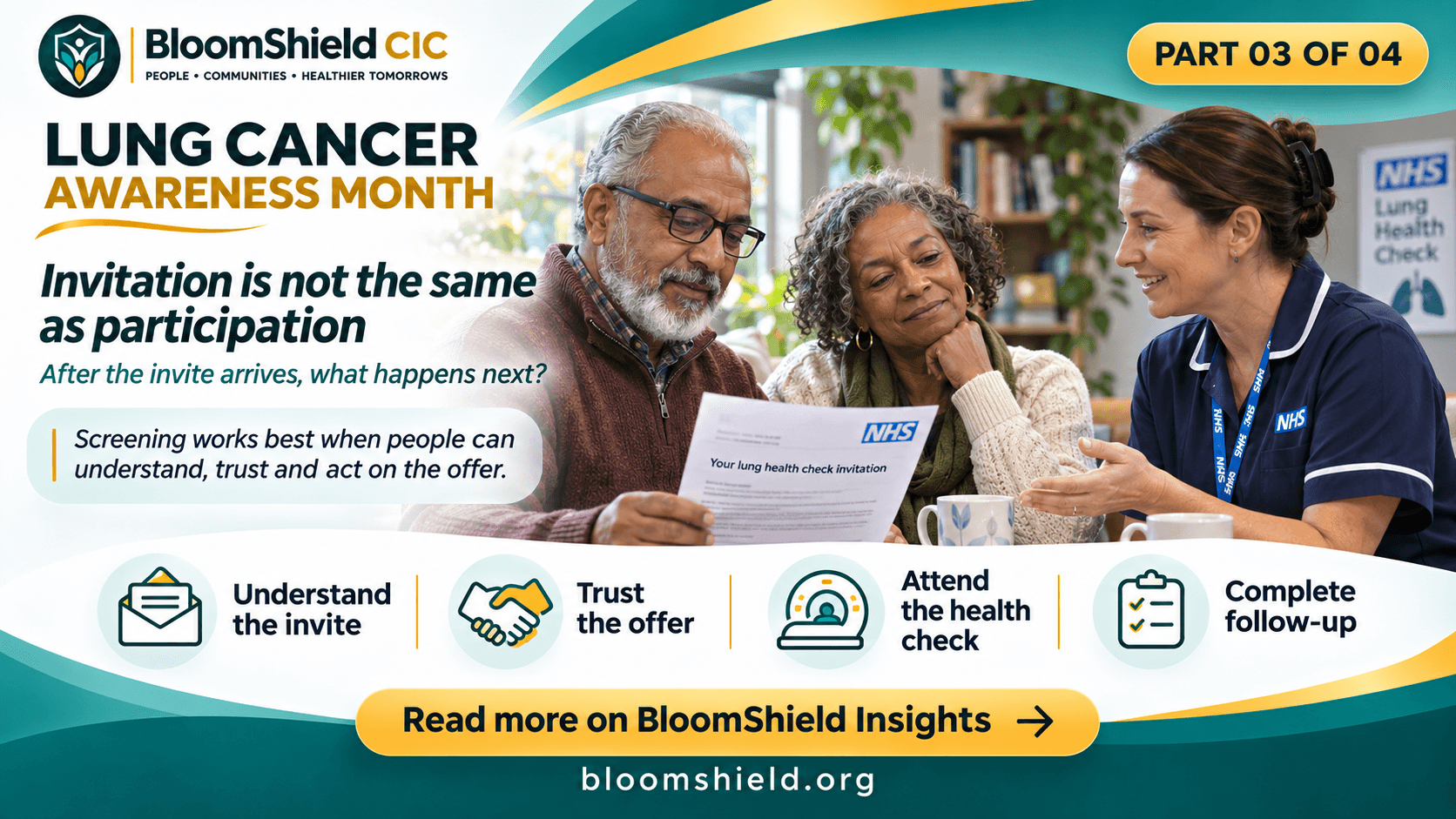
Lung Cancer Awareness Month | Part 3 of 4
An invitation can open the door to lung cancer screening.
But it cannot guarantee that someone walks through it.
England’s lung cancer screening programme is expanding, giving more people at higher risk of lung cancer the opportunity to receive a Lung Health Check and, where appropriate, a low-dose CT scan.
That matters.
But screening effectiveness depends on more than identifying who is eligible and sending an invitation.
The next question is:
What happens after the invitation arrives?
From invitation to participation
For someone to benefit from screening, several things may need to happen.
They need to recognise what the invitation is.
They need to understand why they have received it.
They need to trust the offer.
They may need to answer a telephone call, complete a risk assessment, arrange or attend an appointment and, if recommended, proceed to a low-dose CT scan.
Each step creates an opportunity for participation.
It can also create an opportunity for someone to be lost from the pathway.
That is why:
Invitation is not the same as participation.
Why people may not take up the offer
There is rarely one explanation for screening non-participation.
Practical barriers can matter.
Someone may be working when an appointment is offered.
Transport may be difficult.
Caring responsibilities may compete for their time.
Contact details or smoking history held by healthcare services may be incomplete or out of date.
But practical barriers are only part of the picture.
Some people may not immediately understand why they are being approached when they feel well.
Others may worry about what a scan could find.
Previous experiences of healthcare can influence trust.
The association between lung cancer and smoking may also create feelings of stigma, guilt or fear of judgement.
These factors can shape whether an invitation becomes action.
Screening is designed for people who may feel well
This distinction is important.
Lung cancer screening is intended to identify cancer earlier in people who may not have symptoms.
The current NHS programme invites eligible people aged 55 to 74 who currently smoke or have smoked in the past for a Lung Health Check.
People assessed as being at higher risk may then be offered a low-dose CT scan.
Someone experiencing possible symptoms of lung cancer should not wait for a screening invitation. They should seek medical advice.
Screening and symptomatic diagnosis are different routes into the cancer pathway.
Earlier detection is already making a difference
The value of lung cancer screening is increasingly visible.
NHS England reported in May 2026 that more than 10,000 lung cancers had been identified through the programme since its launch, with more than three-quarters found at stages 1 or 2.
Finding cancer earlier can create more treatment options and improve the possibility of successful treatment.
But those benefits depend on people reaching the screening pathway in the first place.
Expansion therefore needs to be considered alongside participation.
Who receives an invitation?
Who responds?
Who completes the Lung Health Check?
Who proceeds to CT when recommended?
And who does not — and why?
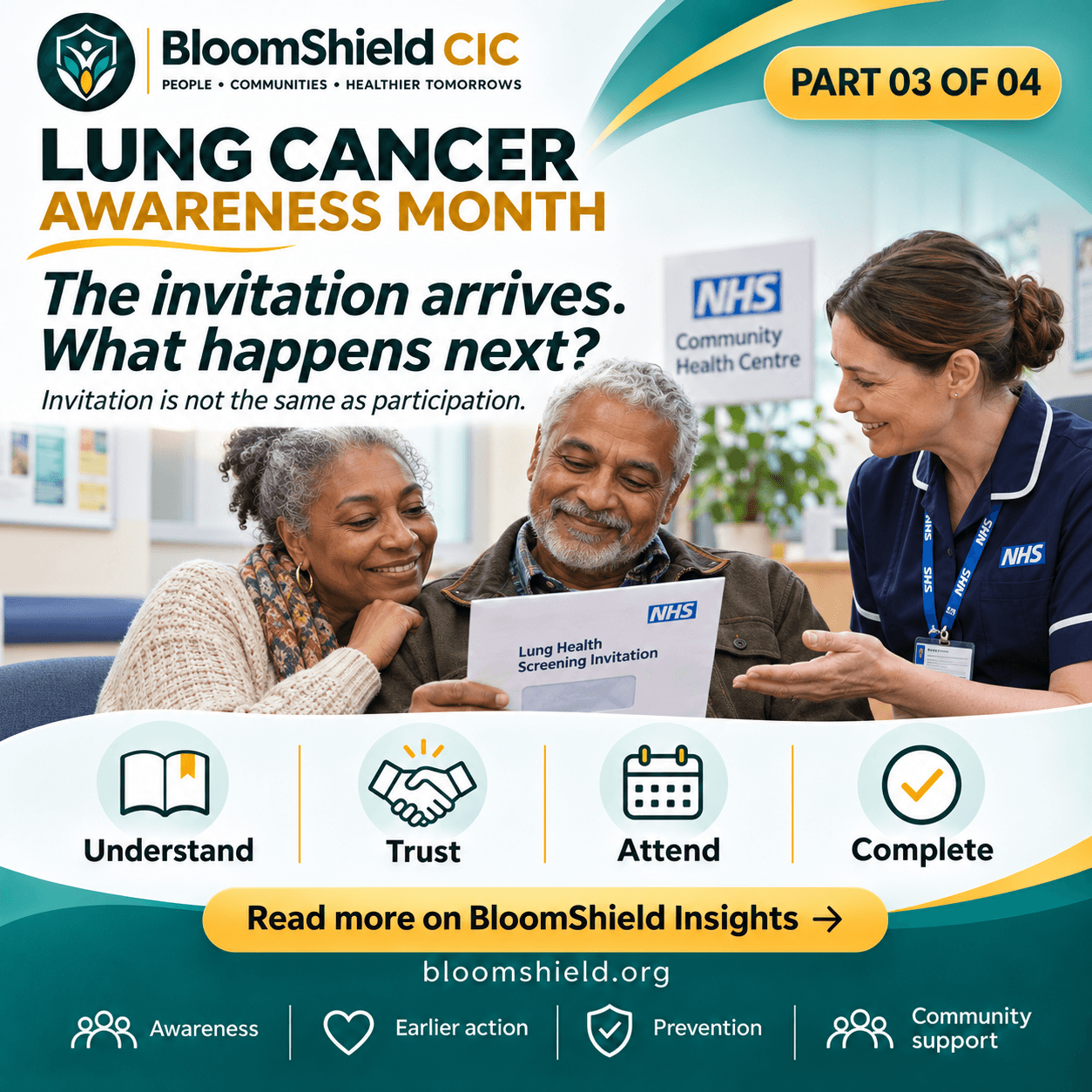
The access question
A screening programme can be clinically effective and still produce unequal benefit if some communities are less able to participate.
That is why screening inequalities cannot be understood from invitation numbers alone.
We also need to understand the barriers between:
Eligibility → Invitation → Participation → Screening → Follow-up
Some barriers may be addressed through clearer communication.
Others may require flexible delivery, convenient locations, trusted community engagement or better navigation through the pathway.
The solution will not be identical everywhere.
Understanding where people disengage — and why — is therefore as important as measuring how many invitations were sent.
The wider lesson
The expansion of lung cancer screening is an important opportunity for earlier diagnosis.
But coverage is only one measure of success.
The deeper question is whether eligible people can understand, trust and act on the offer they receive.
Because the invitation matters.
The screening test matters.
And so does everything that happens between them.
Invitation ≠ Participation.
Next in the series — Part 4: From screening to pathway: what happens after something is found?
Sources & further reading
Contributor
About the author
BloomShield CIC
BloomShield CIC connects evidence, communities and implementation to advance equitable cancer prevention and earlier diagnosis.
How did this insight land with you?
Corrections, evidence or partnership follow-up
Suggest a correction, share relevant evidence or explore a partnership.
Lung Cancer Awareness Month 2026
- Part 1 — Know the signs
- Part 2 — Know the screening offer
- Part 3 — Invitation is not the same as participation
- Part 4 — From screening to pathway (upcoming)
Cancer Care Partnership Ecosystem
CCPE Lens
This Insight is indexed through the domains most relevant to implementation and equitable impact.
Cross-cutting domains
- People
- Equity
- Impact