
Community / independent navigation
- Engagement and intake
- Barrier identification
- Navigation support
- Referral / signposting
- Follow-up
- Programme assurance
BloomShield Programme Portfolio · Volume 3
Connecting People. Connecting Care. Connecting Outcomes.
ScreenConnect™ is BloomShield's patient-navigation and care-coordination programme, designed to identify and overcome barriers that prevent people progressing through the cancer care continuum—from screening and referral through diagnosis, treatment, follow-up and survivorship.
Programme overview
Cancer pathways can be fragmented. Practical, emotional, cultural, communication, digital and system barriers can delay diagnosis or treatment and lead to avoidable loss to follow-up—even when screening and clinical services are available.
ScreenConnect™ is BloomShield's navigation solution: an evidence-informed patient-navigation and care-coordination framework that identifies barriers, clarifies next steps, supports referrals, tracks progress and coordinates follow-up across the cancer care continuum.
It adds a human navigation and implementation layer around existing services, helping people remain connected while clinical responsibility stays with qualified healthcare professionals.
ScreenConnect Digital™
ScreenConnect Digital™ is a proposed digital navigation and pathway-assurance platform designed to strengthen continuity between community and VCSE-led cancer engagement and established screening and referral pathways.
It is being developed to help programmes track progression from engagement to referral, screening and completed next steps; coordinate navigation support; identify pathway drop-off; and provide clearer outcome and inequalities reporting.
ScreenConnect Digital™ is intended to complement—not replace—clinical systems.
Two utilisation modes
NHS clinical systems remain authoritative for clinical information and decisions.
Initial APP-002B focus
The immediate product focus is community engagement → screening/referral → navigation → completed next step → measurable outcome. It does not propose to manage the full diagnosis, treatment or survivorship pathway.
Emerging design principle
Participant-reported Navigator-confirmed Provider-confirmed System-verified
These proposed verification levels are an emerging design principle, not a statement that all four are currently implemented.
Pathway continuity
Swipe horizontally to explore the pathway
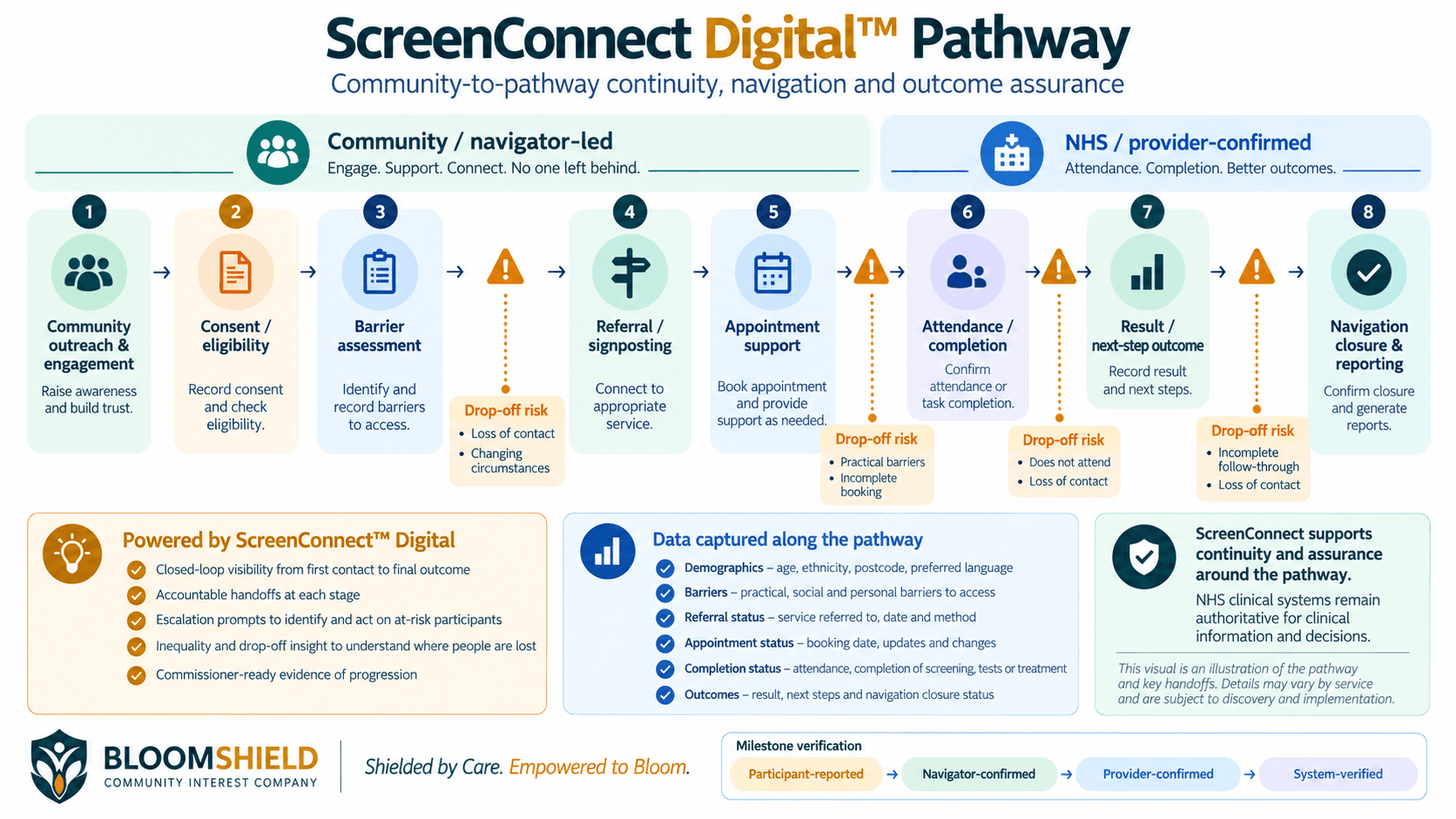
A detailed ScreenConnect Digital™ discovery and product-development dossier is available to prospective NHS, research, commissioning and delivery partners on request.
Where barriers occur
Barriers to care can overlap and change over time. Identifying them early helps partners tailor navigation support to the person and the pathway.
Cancer care continuum
The cancer care continuum describes the connected stages of prevention, screening, referral, diagnosis, treatment, follow-up and survivorship. ScreenConnect™ supports people to understand and move between these stages; clinical decisions and responsibility remain with qualified healthcare professionals and recognised services.
Why patient navigation matters
Patient navigation does not replace clinical care. It helps people address barriers, understand next steps and remain connected to appropriate services.
Helping people understand and complete appropriate next steps may reduce avoidable delays to diagnosis.
Care coordination can strengthen connections between community, screening, diagnostic and treatment services.
Structured patient tracking and follow-up can help identify when someone risks becoming disconnected from care.
Clear information and practical, culturally responsive support can make complex pathways easier to navigate.
Barrier-led navigation can focus support where practical, communication, digital and system barriers are greatest.
Vision
To create an intelligent and inclusive navigation ecosystem that keeps every person connected to the right care, at the right time, throughout the cancer journey.
Mission
To reduce loss to follow-up by combining patient navigation, digital communication, care coordination, implementation data and community support within one connected pathway.
Five programme pillars
Pillar 1
Clear, practical support through each next step.
Pillar 2
Joining up the people and services around a pathway.
Pillar 3
Inclusive communication chosen around people, not technology alone.
Pillar 4
Proportionate implementation indicators that support learning and service improvement—not a live software platform.
Pillar 5
Navigation designed around people who experience greater barriers.
Illustrative connected patient journey
This sequence illustrates how patient navigation, tracking and follow-up may support an existing care pathway. Clinical responsibility remains with qualified healthcare professionals and recognised services.
Barrier identification
Pre-screening support
Screening
Results
Referral navigation
Confirmatory diagnosis
Patient tracking
Follow-up
Treatment connection
Survivorship
Clear scope
Potential supporting capabilities
As ScreenConnect™ develops through discovery, co-design and evaluation, additional programme capabilities may support delivery. Their final form will depend on user need, pathway design, evidence and implementation requirements.
A trained patient-navigation and community-support workforce.
Implementation dashboards supporting programme monitoring, evaluation and service improvement.
Community organisations and trusted local partners supporting people throughout the pathway.
Intended outcomes
ScreenConnect™ aims to support these outcomes. Results will depend on context, delivery partners and the approaches agreed; no clinical or financial outcome is guaranteed.
BloomShield programme portfolio
Builds awareness, confidence and demand for screening.
Core question
Will people take action?
Removes practical, geographic, financial and structural barriers to screening.
Core question
Can people reach the service?
Supports navigation, referral completion, treatment and follow-up.
Core question
Will people complete the pathway?
ScreenSmart Communities™ inspires action.
ScreenAccess™ enables access.
ScreenConnect™ sustains the journey.
CCPE implementation pathway
Aligned with BloomShield’s Cancer Care Partnership Ecosystem.
Map the pathway, communities, services, barriers and points where people are lost.
Bring together patients, navigators, community organisations and healthcare providers.
Deliver coordinated information, reminders, practical support and follow-up.
Measure attendance, referral completion, experience, equity and implementation outcomes.
Strengthen and extend approaches that prove feasible, acceptable and effective.
Commissioning and partnership
ScreenConnect™ can be commissioned or developed in partnership for local, regional, national and international cancer pathways. Scope, delivery model, governance and evaluation measures are agreed with each commissioning partner.
Programme development
ScreenConnect™ is intended to complement established services. Delivery models, communication channels, evaluation measures and governance will be agreed with partners and communities.
Clinical responsibility: Diagnosis, treatment, urgent care and clinical judgement remain the responsibility of appropriately qualified professionals and recognised health services.
BloomShield Programme Portfolio · Volume 3
A concise introduction to the programme's purpose, model, implementation approach and intended outcomes.
Download Programme OverviewPDF · 7 pages · 22.03 MB · opens in a new tab
Connecting the pathway
Work with BloomShield to explore a human, inclusive and evidence-informed approach to patient navigation and care coordination.
Discuss a ScreenConnect™ Partnership