

What Happens When Cervical Screening Adapts to the People It Serves?
Local Lens 007 — Bedford
At one Bedford GP practice, cervical screening uptake rose following a programme of service improvements. The results raise a wider question: should screening services adapt more deliberately to the people they are trying to reach?
By Dr Femi Olaleye
Global Health Specialist & Cancer Prevention Expert | Founder & CEO, BloomShield CIC
7 min read
Published by BloomShield CIC
View approved Bedford artwork at full size
An invitation is not the same as participation
What if the problem is not simply that people are failing to respond to cervical screening invitations — but that the service itself needs to become easier to access?
That question takes us to Cauldwell Medical Centre in Bedford, where a quality-improvement initiative examined how changes to communication, appointment flexibility and patient engagement might improve cervical screening participation.
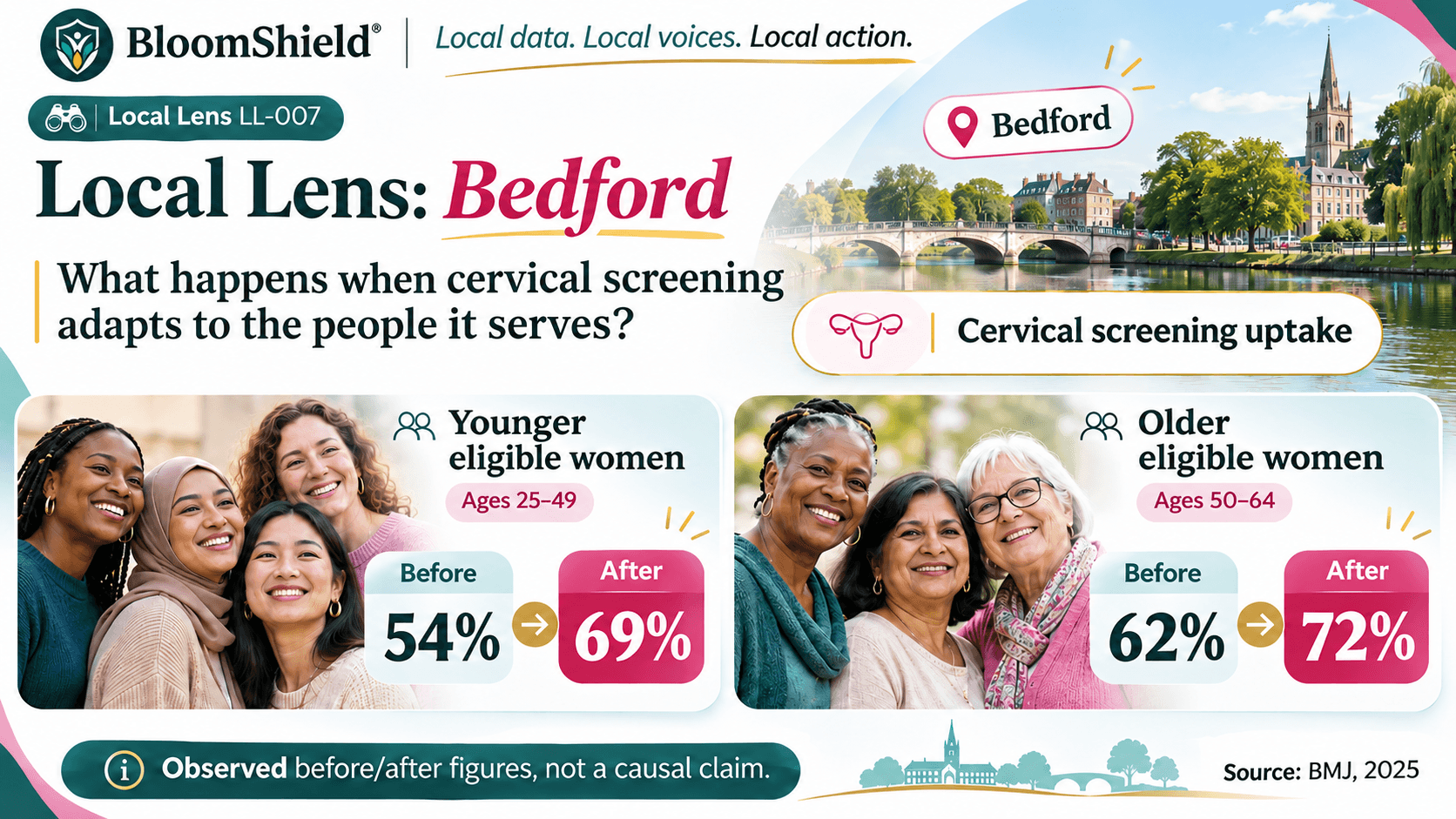
In June 2022, recorded screening uptake stood at 54% among eligible women aged 25–49, compared with 62% among women aged 50–64.
A screening service was available. But participation was uneven.
The practice set out to understand and address the barriers behind that gap.
What did Cauldwell change?
Between June 2022 and March 2023, the practice implemented eight Plan–Do–Study–Act quality-improvement cycles.
The changes included:
- More flexible access: evening appointments and self-booking options.
- More relevant communication: culturally sensitive, easy-read information and personalised GP invitations.
- Community engagement: working with community connectors to support participation among underserved groups.
- Continuous learning: monitoring uptake, testing approaches and adapting the intervention programme.
Rather than relying on reminders alone, the team sought to make screening more accessible and responsive to its patients.
What happened?
By March 2023, the practice reported:
| Eligible women | June 2022 | March 2023 | Change |
|---|---|---|---|
| Ages 25–49 | 54% | 69% | +15 percentage points |
| Ages 50–64 | 62% | 72% | +10 percentage points |
The difference between the two age groups narrowed from eight percentage points to three.
These findings were published by Santos and colleagues in BMJ Open Quality on 11 August 2025.
The results are encouraging, particularly for younger eligible women, whose recorded uptake was initially lower.
But there is an important distinction.
The study documented improvement during the intervention period. It did not establish which individual changes caused that improvement.
This was one GP practice, not a controlled trial. The findings cannot automatically be generalised to Bedford as a whole, nor do they establish improved cancer outcomes.
What can we learn?
Cauldwell's experience illustrates a practical principle:
Screening availability does not guarantee screening accessibility.
An invitation may reach someone who cannot easily attend during working hours, does not understand the information provided, or needs reassurance from a familiar clinician.
Changing those conditions may be as important as increasing the number of invitations.
The Bedford study suggests that local services can identify barriers, introduce practical changes and monitor whether participation improves.
The next challenge is determining which approaches work best, for whom, and whether improvements can be sustained.
Where BloomShield comes in
At BloomShield, this is the gap between identifying an inequality and understanding how to address it.
Our approach follows a connected sequence:
Understand → Validate → Implement → Evaluate → Scale.
The Bedford experience demonstrates why implementation and evaluation must go together.
It also connects with the research questions behind ScreenConnect Digital™, BloomShield's working synthetic-data research demonstrator.
ScreenConnect Digital™ is designed to support exploration of the screening journey:
Invitation → Barrier → Intervention → Attendance → Result → Follow-up → Outcome.
Could better pathway intelligence help researchers and services identify where people disengage, understand the support offered, and investigate what happens afterwards?
That is the opportunity we want to explore through research collaboration — not a claim that our demonstrator has already produced or validated the Bedford results.
The question Bedford leaves us with
Cauldwell Medical Centre reported improved cervical screening uptake after introducing a coordinated programme of service changes.
The study does not tell us precisely which intervention made the difference.
But it leaves us with a useful question:
If screening participation can improve when services become more responsive, how do we identify which changes work, for whom, and under what conditions?
That is a question worth taking beyond Bedford.
Local data. Local voices. Local action.
Continue the conversation
Explore ScreenConnect Digital™
Learn how BloomShield is developing research infrastructure to investigate screening access, pathway continuity and implementation outcomes.
https://bloomshield.org/research/screenconnect
Read the ScreenConnect Digital™ unveiling
https://bloomshield.org/insights/innovation-in-practice/screenconnect-digital-research-demonstrator
Research and implementation collaboration
BloomShield welcomes conversations with primary care teams, researchers, Cancer Alliances and community organisations interested in understanding what improves screening access.
Primary reference
Santos C, Roye J, Tucker J, Guevara C. (2025). Enhancing equity and efficiency in cervical screening uptake: a multidisciplinary quality improvement initiative. BMJ Open Quality, 14(3), e003111.
Published: 11 August 2025.
Study period: June 2022 – March 2023.
https://doi.org/10.1136/bmjoq-2024-003111
Evidence note: Figures refer to reported practice-level uptake at Cauldwell Medical Centre, not Bedford-wide screening coverage. The before-and-after comparison does not establish the causal effect of individual interventions.
How did this insight land with you?
Contributor
About the author
Dr Femi Olaleye
Global Health Specialist & Cancer Prevention Expert
Founder & CEO, BloomShield CIC
Dr Femi Olaleye is a global health specialist and cancer prevention expert, and the founder of BloomShield CIC. His work focuses on equitable cancer prevention, screening access, implementation, community engagement and partnerships that translate evidence into practical improvements in cancer care.
Corrections, evidence or partnership follow-up
Suggest a correction, share relevant evidence or explore a partnership.
Cancer Care Partnership Ecosystem
CCPE Lens
- Understand
- Validate
- Implement
- Evaluate
- Scale
This Insight is indexed through the domains most relevant to implementation and equitable impact.
Cross-cutting domains
- People
- Partnerships
- Systems
- Equity
- Impact